REVIEW · EDINBURGH
Edinburgh: Guided Tour in French
Book on GetYourGuide →Operated by Tours et Détours d'Edimbourg · Bookable on GetYourGuide
Two towns in two hours? Works here. This French guided tour is one of the fastest ways to connect Edinburgh’s Old Town and New Town and understand what you’re actually looking at—street by street. I especially liked the architectural contrast you walk between (tight medieval lanes to formal neoclassical avenues) and the easy-to-follow audio setup. The only real catch is simple: the tour is French only, so plan around that if you don’t feel comfortable.
What makes it feel smooth is the live audio guiding system. You get a guide microphone setup plus a receiver and earphone, so you don’t have to chase the guide to hear what matters.
And because it’s built for a first visit, the pace is practical. In about 2 hours, you’ll hit key landmarks like St Giles Cathedral and the Scott Monument, while learning the stories that connect the UNESCO-listed parts of the city.
In This Review
- Key things to know before you go
- Why this French tour is a smart first step in Edinburgh
- Getting oriented at Grassmarket (and why the start location helps)
- Old Town streets called Proches: what you’ll notice as you walk
- A practical tip for the Old Town segment
- St Giles Cathedral: why it’s more than a photo stop
- Moving into the New Town: neoclassical streets and Franco-Scottish connections
- Scott Monument: using one landmark to understand the city’s mindset
- The architecture lesson you’ll keep using after the tour
- Audio system and group pace: hearing the guide without losing the walk
- Who benefits most from the audio system?
- What you’re paying for: value at about $43 per person
- Who this tour suits best (and who might skip it)
- Should you book this Edinburgh French guided tour?
- FAQ
- How long is the Edinburgh guided tour in French?
- What language is the tour guide?
- Where do I meet the guide?
- How do I get to the meeting point by bus?
- Is entry to monuments included?
- What audio equipment is provided?
- Can I cancel, and is pay later available?
Key things to know before you go

- French language guidance only: You’ll hear explanations in French throughout the tour.
- Audio system = less stress: A microphone and earphones help you keep moving without losing the thread.
- Old Town to New Town mix: You’ll go from the narrow Proches to the elegant New Town streets.
- Landmark passes, not entries: St Giles Cathedral and the Scott Monument are included as sights from the outside (no admission fees included).
- Comfort matters: Wear comfortable shoes and bring waterproof clothing if the weather looks iffy.
- Meet at Grassmarket: The walk starts at the Grassmarket outside Rona’s Bistro and returns there.
Why this French tour is a smart first step in Edinburgh
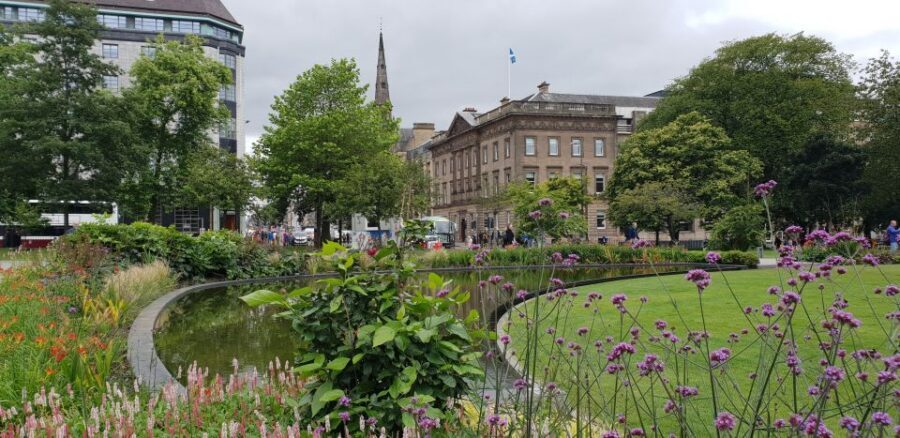
If Edinburgh feels like a maze on arrival, this tour is designed for that exact moment. You’re not just collecting photos. You’re getting a map in your head: how the city’s older part (the Old Town) differs from the planned, elegant part (the New Town), and why that difference still shapes where you walk today.
You’ll also get a guided context for the characters and connections behind the place. The tour focuses on iconic Scotland figures and Franco-Scottish links, which helps when you later read plaques, see monuments, or spot names repeated across neighborhoods.
One more practical bonus: the tour is short—about 2 hours—so you can still build your day around it. This isn’t a half-day commitment that steals your energy. It’s the “get oriented” block.
You can also read our reviews of more guided tours in Edinburgh


Getting oriented at Grassmarket (and why the start location helps)

You meet at Grassmarket, outside Rona’s Bistro. That matters more than it sounds. Grassmarket sits right at the edge of the Old Town’s energy, so you start in an area that feels active but still close to the places the tour is teaching you to recognize.
If you’re using the bus, you’ll find it convenient because routes including 27, 23, 41, 42, 45, and 67 stop on George IV Bridge, then it’s about a 5-minute walk from there. That “short walk after the main stop” style is helpful when you’re traveling light and trying to keep your schedule tight.
And since the tour ends back at the meeting point, you don’t have to solve the “how do we get back?” puzzle at the end. After two hours, your feet will be ready for a pub stop or a quick regroup.
Old Town streets called Proches: what you’ll notice as you walk
The Old Town portion is built around the narrow streets known as Proches (you’ll hear that term during the tour). Walking these lanes with a guide helps because the space compresses your sense of scale. From inside the maze, it’s easier to understand how the Old Town evolved and why the buildings and streets feel close and vertical.
Expect your guide to point out architectural patterns as you go—how window shapes, street width, and building forms create a mood all their own. This is the kind of lesson that makes later self-guided wandering easier. After you’ve seen the Old Town through this lens, you start recognizing the logic of the place instead of treating it like random stone corridors.
Also, this portion is where the “atmosphere” part becomes real. You’re in the oldest layers of the city layout, so the streets feel more like a lived-in puzzle than a museum set.
A practical tip for the Old Town segment
This is a walking tour. In practical terms, comfortable shoes are non-negotiable, especially since the streets can be uneven and narrow. If the forecast looks like rain, waterproof clothing will keep the experience enjoyable rather than annoying.
St Giles Cathedral: why it’s more than a photo stop
You’ll pass key landmarks during the tour, and St Giles Cathedral is one of them. The guide uses sights like St Giles to explain how different parts of Edinburgh developed and how the city’s identity is tied to its institutions.
Even without entering any sites, you can still learn a lot just by looking carefully from the outside. The cathedral is an anchor landmark, so it works well as a “look here” point while your guide connects the architectural story you’re following.
For me, the value of a stop like this is how it turns a recognizable building into a reference point. After the tour, you can look back at St Giles and understand why it belongs where it does in the bigger city map.




Moving into the New Town: neoclassical streets and Franco-Scottish connections
Then the tour shifts from the tight Old Town streets into the large elegant streets of the Neoclassical New Town. That contrast is the whole point. Old Town teaches you density and medieval street patterns; New Town teaches you planning, symmetry, and the confidence of a different era.
As you walk, your guide explains architectural styles and how they show up on the streets. You’re not only seeing buildings—you’re learning how to read them. Things like rooflines, facades, and street proportions start to feel less random and more intentional.
This is also where the tour leans into broader themes—Franco-Scottish connections and the iconic characters of Scotland. Those elements add depth to what could otherwise be just “pretty streets.” Even if you don’t know every figure already, the guide’s framing helps you place names and references into a cultural story.
Scott Monument: using one landmark to understand the city’s mindset
The Scott Monument is another must-pass landmark. Like St Giles Cathedral, it’s a visual marker that helps you translate the tour lesson into something you can keep using later.
If you’ve ever stood in front of a big monument and felt unsure what you’re looking at, this tour helps. Your guide uses the Scott Monument as part of the architecture and identity story—how Edinburgh celebrates key parts of its culture and how that shows up in stone.
For your own day after the tour, this is handy. You can later decide whether to return for photos, spend time nearby, or plan a longer route that builds on what you learned.
The architecture lesson you’ll keep using after the tour
One of the best outcomes of this kind of guided walk is that it trains your eyes. When you hear about the city’s architectural styles and then immediately see the contrast yourself, you remember it.
Here’s what tends to click for people on this route:
- You stop treating Old Town as just “old.” It becomes “dense, narrow, and built to fit an older layout.”
- New Town becomes “planned and formal.” You begin noticing proportions and how streets feel designed rather than grown.
- Landmarks aren’t isolated. St Giles and the Scott Monument start to make sense as anchors in the bigger layout.
This is one reason the tour works as an intro. You’re not memorizing a lecture. You’re collecting a set of visual cues.
Audio system and group pace: hearing the guide without losing the walk
This tour stands out for how it handles sound. The guide uses a live audio system with a microphone and you receive a receiver with an earphone. That means you can keep walking at the group’s pace without constantly turning your head to find the speaker.
If you prefer, you can bring your own jack earplugs. It’s a nice option if you’re picky about ear comfort or want your own hygiene setup.
A review-style highlight that you should expect in practice: the microphone + earpieces setup makes it easier to move freely. In other words, you’re less likely to get trapped at the front or frustrated at the back.
Who benefits most from the audio system?
Anyone who’s felt the pain of whispery street tours will appreciate it—especially in a city like Edinburgh where streets can be busy and noise bounces around.
What you’re paying for: value at about $43 per person
At around $43 per person for a roughly 2-hour group tour, you’re paying for three things:
- A French guide who provides structured context (not random sightseeing).
- Live audio equipment, which makes a real difference on a moving street tour.
- A route that covers the UNESCO-linked “two-town” overview in a compact time window.
What you’re not paying for is entry tickets. That’s good if you want an affordable orientation walk, and it also keeps the tour moving since you’re not stopping for long ticket lines.
In terms of value, this price makes sense if you want guidance for what to look at and how the city pieces connect. If you’re the type who already loves studying architecture on your own, you might spend less by self-guiding—but you’d be trading away the structured explanation.
Who this tour suits best (and who might skip it)
This is a great fit if:
- You’re visiting Edinburgh for the first time and want a fast orientation to Old Town + New Town.
- You like architecture and want the differences explained while you walk.
- You want a French-led experience and you’re comfortable understanding French.
- You’d rather pay for a guide plus audio than for multiple paid entries.
It may be less ideal if:
- You need English guidance.
- You’re hoping for a tour packed with inside-the-building visits, since the tour does not include entry tickets.
Should you book this Edinburgh French guided tour?
I’d book it if you want to start Edinburgh the right way: see the two UNESCO-listed town areas as connected neighborhoods, learn the architectural styles while your feet are moving, and leave with a clearer mental map.
If you’re comfortable in French and you appreciate practical guidance with an audio system, this is an efficient use of your first day. The tour keeps to the outside sights you can revisit later, like St Giles Cathedral and the Scott Monument, which is ideal for building a flexible itinerary afterward.
If French is a deal-breaker, you’ll want to look for an English option instead. Otherwise, this one is a smart, low-commitment foundation.
FAQ
How long is the Edinburgh guided tour in French?
The duration is 2 hours.
What language is the tour guide?
The live tour guide speaks French.
Where do I meet the guide?
Meet at Grassmarket, outside Rona’s Bistro.
How do I get to the meeting point by bus?
Bus options include 27, 23, 41, 42, 45, and 67 on George IV Bridge, then it’s about a 5-minute walk.
Is entry to monuments included?
No. Entries to visitor attractions and monuments are not included.
What audio equipment is provided?
The tour includes a live audio guiding system with a receptor and earphone. You can also bring your own jack earplugs if you prefer.
Can I cancel, and is pay later available?
Free cancellation is available up to 24 hours in advance for a full refund, and you can reserve now and pay later.