REVIEW · EDINBURGH
Makars Mushroom Farm Summerhall Tour with DIY Block Making
Book on GetYourGuide →Operated by Makars Mushroom Farm · Bookable on GetYourGuide
Mushrooms feel like science magic until you see it close up. In an underground basement at Edinburgh’s Summerhall, I love how this 1-hour visit turns fungi from a spooky mystery into a simple, repeatable growing routine. You’ll get hands-on time to inoculate your own block, and you’ll also walk through sterile growing conditions and fruiting tents where oxygen, water, and nutrients matter. The one clear catch: the tour happens in a disused underground basement, so it may not work well if you get claustrophobic.
I also really like the way the tour keeps things practical, not preachy. You start with how Lion’s Mane is produced step by step, then you end with a take-home block and timelapse viewing so you can picture what’s happening after you leave. It’s suitable for all interest levels, but if you want long, leisurely wandering, you might find the format a bit fast (it’s a tight, focused hour).
In This Review
- Key Highlights Worth Your Time
- An Underground Mushroom Workshop at Summerhall
- The Lion’s Mane Story: Grain, Incubation, and Fruiting
- Why Sterility Matters (And How the Tour Shows It)
- Fruiting Tents and What You Monitor Before Harvest
- Inoculate Your Own Block: The Best Take-Home Part
- How Much Time Do You Get, Really?
- Price and Value: Why $13 Can Actually Make Sense
- Getting There: Summerhall Directions Without the Headache
- Who Should Book This (And Who Should Skip It)
- Should You Book the Makars Mushroom Farm DIY Block Tour?
- FAQ
- How long is the Makars Mushroom Farm Summerhall tour?
- What mushrooms does the tour focus on?
- What will I do at the end of the tour?
- About how soon will my block fruit?
- Where do I meet for the tour at Summerhall?
- How large is the group?
- Is the tour suitable for children or wheelchair users?
- Is there free cancellation?
Key Highlights Worth Your Time
- Underground farm setting inside Summerhall, in a disused basement that makes the whole process feel real
- Lion’s Mane cultivation, from grain production to incubation and fruiting
- Sterile growing techniques explained in plain language so you understand what must stay controlled
- Fruiting tent monitoring, including what to watch for in oxygen, water, and nutrients before harvest
- Inoculate your own block and take it home to fruit in about three weeks
- Timelapse videos that show how the fruiting process unfolds after you leave
An Underground Mushroom Workshop at Summerhall
This tour starts at Makars Mushroom Farm, tucked into a disused underground basement beneath Summerhall in Edinburgh. The space is part of the experience. Above ground, you’re just in a normal arts-venue area. Down below, everything shifts into controlled farming mode—cleaner, quieter, and clearly designed around sterility and steady conditions.
I like that you’re not asked to pretend you’re a scientist. The guide explains the logic: fungi aren’t growing well because of luck. They grow because you manage variables. Once you hear that, the whole operation makes sense. You’re basically learning how to run a tiny, reliable “mushroom factory.”
There’s also a fun, human side to the vibe. The tour guide is described as friendly and engaging, with an informal energy that makes questions easy. One review even mentioned the guide making handmade mushrooms for Valentine’s Day, which is a small moment, but it tells you the team is invested in making the experience feel warm, not robotic.
One more important note for planning: the tour isn’t wheelchair-friendly and the basement setup may not be suitable if you struggle with tight spaces. If you know you’ll feel uneasy underground, take that seriously before you book.
You can also read our reviews of more tours and experiences in Edinburgh.


The Lion’s Mane Story: Grain, Incubation, and Fruiting
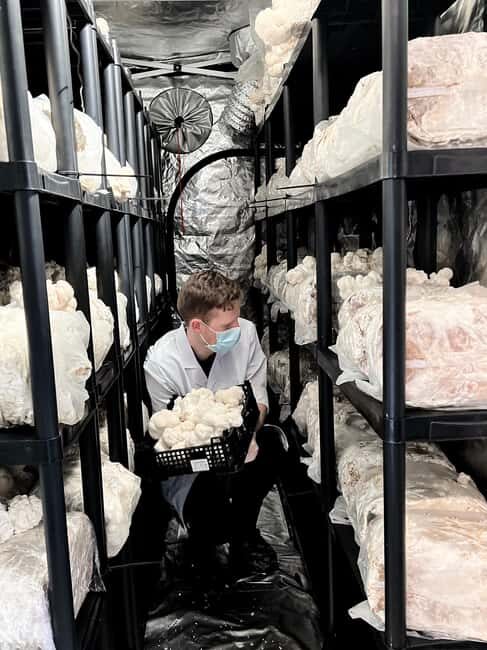
You’ll focus on Lion’s Mane mushrooms, and the tour moves in a logical sequence. First you learn how the process begins with grain production. It’s a key detail because you’re not just watching mushrooms. You’re learning where the growing material starts and why that matters for later steps.
Then comes incubation—where the conditions are controlled so the fungi can colonize properly. This part is where the tour earns its keep. Sterile growing isn’t just about cleanliness for cleanliness’ sake. It’s about preventing contamination so the mushroom system you want has the best shot.
When you reach fruiting, you’ll see how the farm environment changes. Instead of thinking only about colonization, you shift to how the mushrooms actually emerge and develop. That makes the tour more than a lecture. You’re given a mental map you can carry home: grain production sets up the start, incubation prepares the material, and fruiting is where you can finally see results.
If you’re the type who likes understanding how things work, you’ll appreciate the way the guide connects each step to outcomes you can later recognize. And if you’re brand-new to fungi, it still lands because the explanation stays practical.
Why Sterility Matters (And How the Tour Shows It)
A lot of people think growing mushrooms is basically mist and patience. This tour challenges that gently. You’ll learn how Lion’s Mane is grown in a sterile environment, and you’ll see how carefully the work is set up to keep contaminants out.
You’ll learn about the techniques required to grow exotic mushrooms reliably. That phrase matters: reliability is the difference between a fun experiment and something that actually produces consistent results.
The tour also frames fungi in a bigger context. You’ll hear that fungi are considered the third branch in evolution, and the talk ties that to the real-world appeal of fungi as nutritious food—with benefits that people associate with both meat and plants. You don’t have to be into biology to get the point. It’s there to show why anyone bothers building an operation like this in the first place.
The best part is that “sterile” isn’t treated like a scary word. It’s explained as a set of rules you can see: controlled conditions, careful handling, and monitoring. That turns the whole subject from abstract into doable.
Fruiting Tents and What You Monitor Before Harvest
Next you’ll visit the fruiting tents, where the operation shifts again. This is where you learn that fruiting doesn’t happen automatically. The farm team watches conditions and makes sure the crop has what it needs.
The guide walks you through monitoring factors like oxygen, water, and nutrients. You also learn what to look for in the mushroom crop before harvest. That’s valuable even if you never grow mushrooms again, because it teaches you the core idea: harvest timing depends on more than calendar dates.
Also, fruiting tents are one of those visuals that help your brain. Seeing the tents while the guide explains the variables helps you remember the logic later. It’s easier to remember what to watch for when you connect it to a real setup rather than an online video.
This section is one reason the tour feels worth it. A lot of short experiences show you a final product and call it a day. Here you get the “how do they know it’s ready?” part, which is where most people feel lost.
Inoculate Your Own Block: The Best Take-Home Part
The highlight for most people is the practical session at the end. You’ll inoculate your own block to take home. That’s the moment where the tour stops being only educational and becomes personal.
In plain terms, inoculation is how you introduce the right fungi to the growing material. You’re guided through the process, and then you leave with your own starting point. For me, that’s the best value on the schedule because it turns the tour into a continuing project.
Your block is designed to fruit in about three weeks. That timeline is useful for planning, because it gives you a window where you can start checking without obsessing daily. You’ll also watch timelapse viewing of mushroom fruiting, which helps you understand what you should expect as days pass.
This is where the reviews really line up with the experience. People describe the practical block-making session as a great way to end the tour, especially because it gives you something concrete to try at home. Even if you end up not growing again, you still walk away knowing what it takes for mushrooms to develop under good conditions.





How Much Time Do You Get, Really?
The tour is 1 hour, and it moves with intention. That timing is great for a quick Edinburgh add-on. You get explanations, visuals, and the hands-on inoculation segment without turning the visit into a half-day commitment.
The small-group format helps a lot here. The group is limited to 8 participants, which means you’re not disappearing into the back row. It’s easier to ask questions and get your specific “wait, how does that work?” moment answered.
And since the tour is suitable for all interest levels, you don’t need to be a hardcore fungi person to enjoy it. You can come curious or skeptical and still leave feeling like you understood what’s happening.
If you’re someone who likes slow, open-ended museum-style wandering, you may feel the hour is structured (it is). But if you’re like most people—short on time and wanting something useful—this format fits nicely.
Price and Value: Why $13 Can Actually Make Sense
At $13 per person, the ticket price looks like a steal for what you get. You’re paying for access to a functioning mushroom-growing setup, guided instruction on sterile cultivation, and the chance to take home an inoculated block.
The practical session is the big value driver. Many experiences teach you concepts and send you home empty-handed. Here, you leave with a piece of the process so you can see how your learning continues once you’re back in your own space.
You also get timelapse viewing of fruiting, which adds context for what comes next. That matters because it helps you avoid the most common issue: growing attempts that fail because people didn’t understand what changes over time.
In short, the price reflects a balance of education and a takeaway that keeps the experience going. If you like doing things with your hands, this is the kind of ticket that actually feels like more than an hour of talking.
Getting There: Summerhall Directions Without the Headache
Summerhall is walkable through Edinburgh’s Meadows area, and you can bring a bike if you want—bikes can be brought inside or locked in racks. If you prefer public transport, multiple Lothian bus routes stop near South Clerk Street or directly outside the venue’s main entrance.
Inside Summerhall, the meeting point is specific. Go in through the main entrance, walk to the back door where stairs are, go down, and then follow signs for the machine room. Turn left and follow signs to the end of the corridor.
That’s the kind of detail that prevents stress right before your tour. If you arrive a few minutes early, you’ll have time to find it without rushing.
Who Should Book This (And Who Should Skip It)
You’ll likely enjoy this tour if you want hands-on learning, like practical science, or simply enjoy unusual food-growing projects. It works for first-timers because the tour is suitable for all interest levels and focuses on explaining what matters and why it matters.
It’s also a good fit if you like structured experiences. You’ll learn the process from grain production to incubation and fruiting, you’ll see sterile setup and fruiting tents, and you’ll finish with a take-home block and a three-week fruiting expectation.
On the other hand, skip it if you’re looking for an activity for kids under 10 or if you need wheelchair access. The basement setting may also be uncomfortable if you’re claustrophobic, since there is no accessible access.
Should You Book the Makars Mushroom Farm DIY Block Tour?
Yes, if you want a short, high-impact experience that mixes explanation with a real takeaway. The biggest reason to book is the combination of sterile cultivation learning plus leaving with a block you inoculated yourself. That turns the hour into something you can follow at home.
I’d also say book it if you like the idea of learning what to monitor—oxygen, water, nutrients—and what to look for before harvest. Even if you never build a mushroom setup again, that mindset carries over to other hobbies and even cooking.
If you know you’re sensitive to underground spaces or you need accessible access, it’s safer to look for a different kind of activity.
FAQ
How long is the Makars Mushroom Farm Summerhall tour?
The tour lasts 1 hour.
What mushrooms does the tour focus on?
The tour focuses on growing Lion’s Mane mushrooms.
What will I do at the end of the tour?
You’ll inoculate your own mushroom block to take home.
About how soon will my block fruit?
Your block should fruit in about three weeks.
Where do I meet for the tour at Summerhall?
Go in the main entrance, walk to the back door where stairs are, go down the stairs, follow signs for the machine room, then turn left and follow signs to the end of the corridor.
How large is the group?
The group is small, limited to 8 participants.
Is the tour suitable for children or wheelchair users?
It’s not suitable for children under 10, and there is no accessible access for wheelchair users.
Is there free cancellation?
Yes. You can cancel up to 24 hours in advance for a full refund.