REVIEW · CAMBRIDGE ENGLAND
Cambridge: City Sightseeing Hop-On Hop-Off Bus Tour
Book on GetYourGuide →Operated by City Sightseeing UK · Bookable on GetYourGuide
Cambridge can feel like a maze on foot, so this hop-on hop-off bus is a handy shortcut. I like how the route focuses on the city’s top sights in a logical loop, and I also like the 9-language audio guide with headphones for listening on the move. You get 18 stops spread around the center, the University area, and the WWII memorial zone.
One thing to plan for: views can be blocked from the open-top deck by trees, and the onboard audio depends on where you sit (some parts can be harder to hear if the bus is noisy).
In This Review
- Quick hits before you board
- Why this hop-on hop-off bus is a smart first day in Cambridge
- Price and what you actually get for about $22
- Getting on: vouchers, exact stops, and the one rule about mobile tickets
- Timing that affects which places you can actually reach
- A stop-by-stop route you can plan around
- Stops 1–4: your orientation block in the center
- Stops 5–9: the Jesus Lane landmark area and the university-side streets
- Stops 10–11: the practical “get back on” points
- Stops 12–15: museums and city edges you’ll want for a longer look
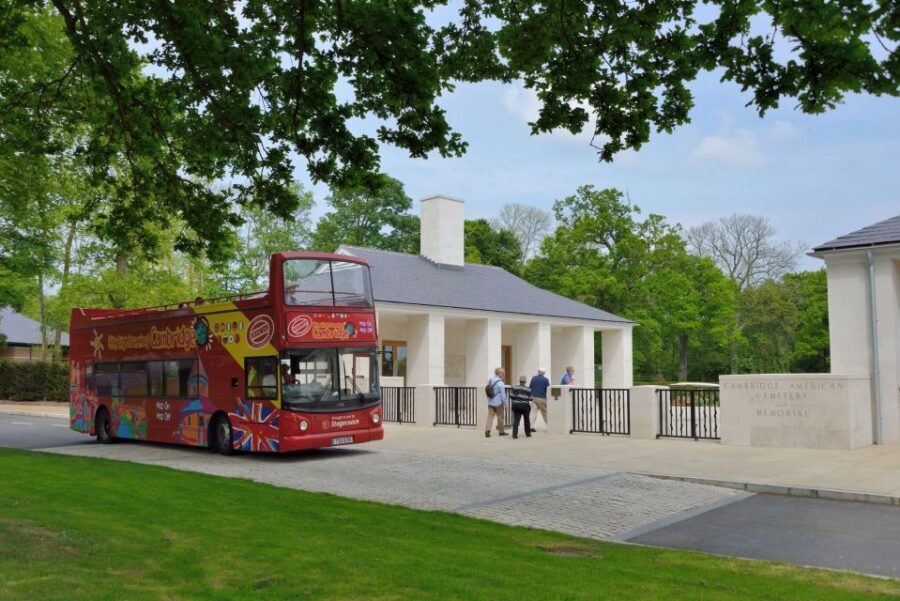
- Stops 16–18: the American WWII memorial and the Madingley area
- Listening on a double-decker: headphones work, but bus noise can win
- Open-top deck realities: views, safety, and shade
- How to use the hop-on hop-off plan for maximum value
- Pairing with punting: worth it, and choose your timing
- Who this bus tour suits best
- Should you book this Cambridge hop-on hop-off bus?
- FAQ
- How long is the bus route?
- How often do the buses run?
- What time is the first and last bus on most days?
- Where can I use a mobile voucher?
- Are attractions included with the ticket price?
- Are pets and large bags allowed?
- Which languages are included in the audio guide?
- Do all stops operate every day?
- When do the later stops (12–18) stop running?
- Is there a family ticket option?
Quick hits before you board
- 18 stops across Cambridge: from the core streets to the American WWII memorial area
- Headphones + 9 languages: Spanish, Chinese, English, French, German, Italian, Japanese, Russian
- You control your pace: hop on, stay aboard, hop off, then rejoin later
- Two museum-style options: hop off near the Fitzwilliam Museum and also toward areas serving the Sedgwick Museum/Museum of Archaeology
- Good daylight timing matters: stops 12–18 stop running after 6:10pm on most days
- Voucher rules can trip you up: mobile vouchers work at Stop 1 (and mobile is accepted at Stop 12 only at the railway station)
Why this hop-on hop-off bus is a smart first day in Cambridge
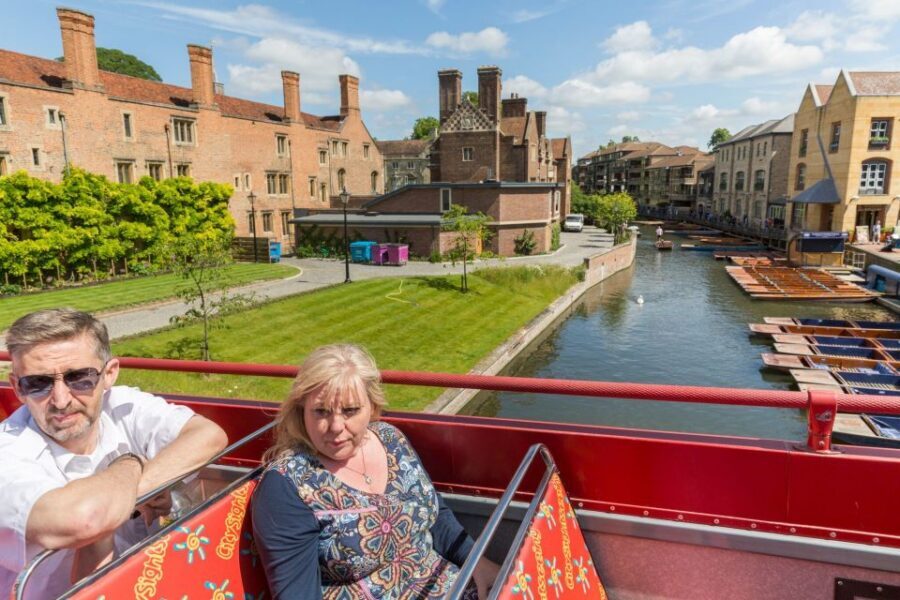
Cambridge is famous for its colleges and its river views, but it’s also a city of narrow streets where planning can eat up your energy. This tour solves that with a repeating loop and a simple idea: ride for orientation, then hop off where you actually want more time.
I especially like that the route isn’t only about one famous postcard spot. You’ll cover the historic city center feel, the university buildings, the famous Backs and River Cam area, and then you can branch out to museums and memorials. It’s the kind of system that helps you get your bearings fast without turning your day into a spreadsheet.
You can also read our reviews of more city tours in Cambridge England

Price and what you actually get for about $22
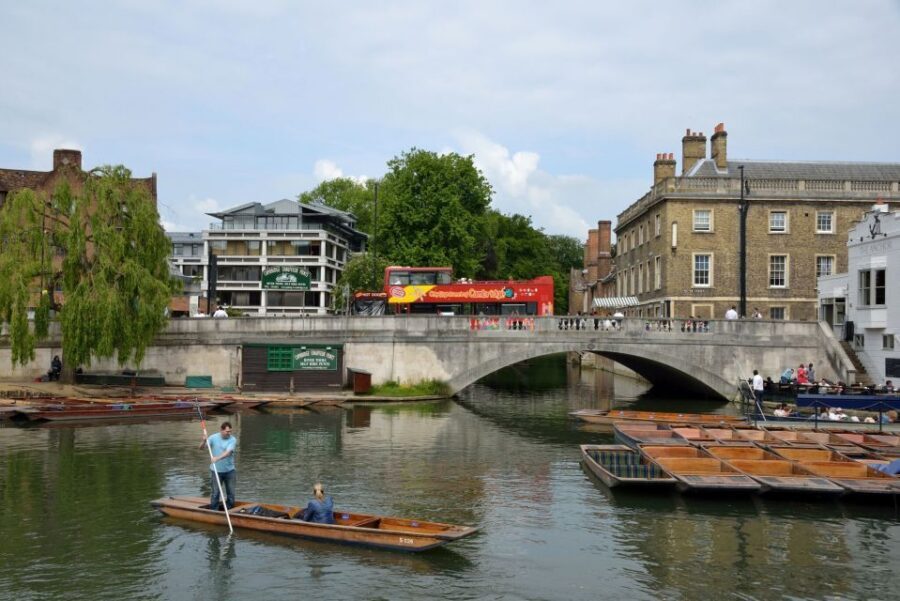
At about $22 per person for a 1-day pass, the value comes from what’s included, not from a single timed attraction. You’re paying for a full-day sightseeing ticket that’s valid for 24 hours, with a loop that typically takes about 80 minutes. In plain terms: you’re buying time on a double-decker with stops close to major sights.
What’s included matters:
- the 24-hour hop-on hop-off bus tour
- audio guide commentary in 9 languages (with headphones)
- a coupon booklet
- stops positioned near major sights
What you’re not buying is attraction entry. Food and drink also aren’t included, so you’ll still want to budget for meals and any ticketed museum sites you choose to enter. For many visitors, that’s fine, because the bus helps you decide which places feel worth paying to go inside.
Getting on: vouchers, exact stops, and the one rule about mobile tickets
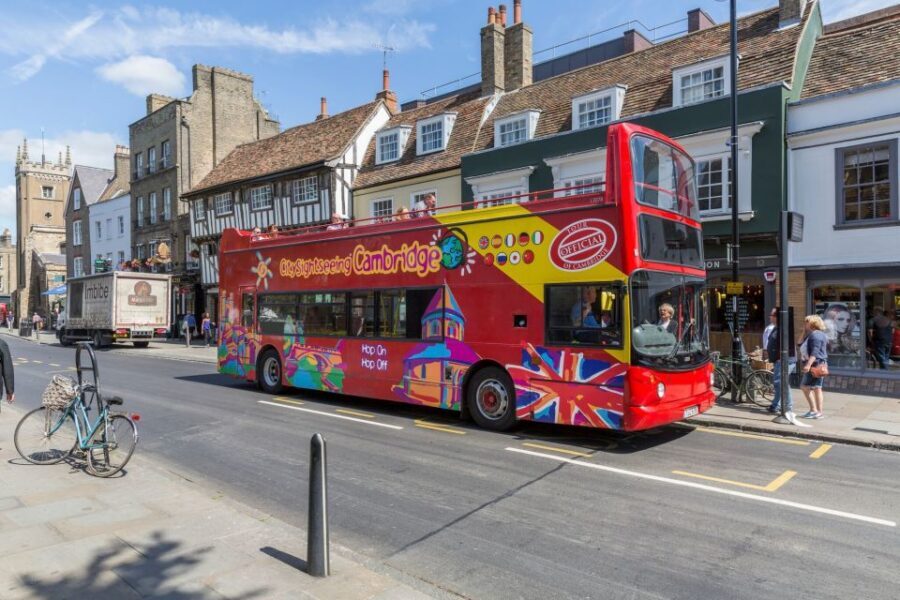
The meeting point is Stop 1: Silver Street. Here’s the practical rule to remember: mobile vouchers are accepted at Stop 1, but paper vouchers must be used if you first hop on at any other stop.
There’s one exception-like note for mobile tickets: mobile tickets are accepted at Stop 12: Cambridge Railway Station only. If you’re planning to start at the railway station, that’s the moment to make mobile work for you.
Also keep in mind:
- no pets
- no luggage or large bags
That last one is more important than it sounds. On an open-top, busy bus, big bags can slow you down and create awkward moments at doors.
Timing that affects which places you can actually reach
This tour runs on a 1-day schedule with these basics:
- Buses depart from Stop 1 at 10:10am
- the last bus departs at 6:10pm
- buses run every 40 minutes
- the full tour duration is 80 minutes
There are day-to-day differences:
- Monday–Saturday (excluding bank holidays): Stops 12–18 won’t be in service after 6:10pm, and Stop 4 (Trinity Street) and Stop 5 (Market Street) are not in service
- Sundays (including bank holidays): Stops 12–18 won’t be in service after 6:10pm, but all stops operate
If you want the WWII memorial area and the more outlying stops (17 and 18), start earlier. You can still squeeze plenty into a day, but waiting until late reduces your choices.
A stop-by-stop route you can plan around
Think of this route as two big goals: do an easy loop for orientation, then pick a couple of stops to linger. Here’s how I’d interpret the stops and what they’re for.




Stops 1–4: your orientation block in the center
- Stop 1: Silver Street is your starting point. This is where you’ll want to begin if you’re using a mobile voucher, and it’s also a good anchor for the historic core.
- Stop 2: Downing Street and Stop 3: Chesterton Lane help you drift away from the main shopping streets without making the day complicated.
- Stop 4: Bridge Street is part of that central rhythm. On weekdays (Mon–Sat excluding bank holidays), this stop may not run.
Tip: If it’s your first time in Cambridge, ride this early stretch to learn where the streets and university areas sit relative to your hotel.
Stops 5–9: the Jesus Lane landmark area and the university-side streets
- Stop 5: Trinity Street (Sundays only) and Stop 6: Market Street (Sundays only) are mainly for Sunday flexibility, so don’t build a weekday plan around them.
- Stop 7: Jesus Lane is a highlight for a reason: this is where you can see All Saints Church on Jesus Lane. It’s a great example of Cambridge’s layered, old-and-new feel.
- Stop 8: Drummer Street and Stop 9: Parkside are useful for repositioning. You’re moving through streets that connect you back toward the university zone and nearby attractions.
Also, the tour is designed so you can hop off toward Sedgwick Museum or the Museum of Archaeology areas. Since those are museum-style stops, it’s smart to plan those as your “I want to go inside” moments rather than just a quick photo stop.
Stops 10–11: the practical “get back on” points
- Stop 10: Hills Road is a handy mid-route stop that keeps options open.
- Stop 11: Railway Station matters because it makes getting back simple. If you’re staying near the station or arriving late, this stop is your safety net.
One logistics note: you’ll find mobile ticket acceptance at Stop 12 only at the railway station, so if you’re trying to rely on phone-based tickets, double-check you’re boarding at the correct stop.
Stops 12–15: museums and city edges you’ll want for a longer look
- Stop 12: Trumpington Road helps extend your day beyond the tight center.
- Stop 13: The Fitzwilliam Museum is one of the easiest “yes, I should get off here” stops because it’s named directly. If you want a museum break, this is where you’re meant to do it.
- Stop 14: Silver Street repeats to give you another central reboarding point.
- Stop 15: Queen’s Road rounds out this city-side portion so you can keep moving without doubling back.
Stops 16–18: the American WWII memorial and the Madingley area
- Stop 16: Cambridge American Cemetery and Memorial is the big WWII anchor. If WWII history is on your list, this stop is worth timing carefully.
- Stop 17: Madingley Road and Stop 18: Grange Road connect toward the broader cemetery/memorial area associated with those who died in WWII.
For this section, the clock matters. On weekdays and Saturdays, the tour warns that stops 12–18 won’t be in service after 6:10pm. So if you want this area, aim to be there earlier rather than treating it as an after-dinner plan.
Listening on a double-decker: headphones work, but bus noise can win
The audio guide is a real part of the value here. You’re not stuck with vague sight-by-sight narration. You get guided commentary in Spanish, Chinese, English, French, German, Italian, Japanese, Russian, and the tour provides headphones, which helps you actually hear the explanation instead of relying on open-air PA sound.
Still, you should keep a couple things in mind based on real-world experience:
- the bus can get noisy, especially with movement between announcements
- at least one audio setup can be affected by the bus’s internal sounds, making certain moments harder to hear
- open-top viewing means sun and wind can change your comfort fast
Practical approach: if hearing is your priority, try for a seat where the speakers and your cabin position make audio clearest. If it’s a hot day, consider shifting your spot as needed. If you’re after photos, pick the side that gives you the best unobstructed angle, and don’t assume every view will be clear from behind trees.
Open-top deck realities: views, safety, and shade
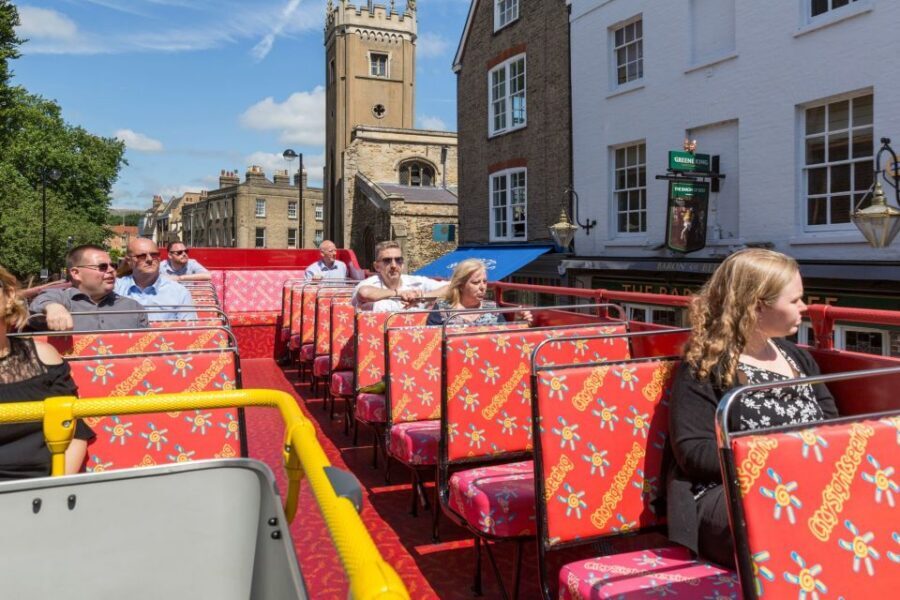
Cambridge is often visually perfect, but open-top buses have real constraints. One downside you might encounter is overgrown trees blocking views, especially at certain sections of the route. It’s not constant everywhere, but it’s enough that you’ll want to stay alert when you see a clear angle ahead.
Also, the open-top deck can feel less stable than an enclosed upper deck on uneven roads. If you’re sensitive to that, you may prefer a more central seat on the top deck or even consider staying on the lower level for parts of the route.
And then there’s the simple comfort factor: on warm days, being outside can be great for air, but it also means you’ll feel the sun. Bring sunglasses and plan for wind shifts.
How to use the hop-on hop-off plan for maximum value
Here’s a practical strategy that works well in Cambridge:
- Ride early to get the layout in your head.
- Hop off at one “inside” place (like the Fitzwilliam Museum).
- Use one stop for the landmark church moment (Jesus Lane for All Saints Church).
- Block in time for the WWII memorial zone if that’s meaningful to you.
Then, when you’re done, rejoin the bus rather than trying to navigate narrow streets when you’re tired.
If you’re hungry, you can also time a lunch break mid-day and come back later. The big win is control: you’re not stuck committing to one continuous walk.
Pairing with punting: worth it, and choose your timing
The tour specifically mentions you can combine the bus with a punting tour. That makes sense because the bus brings you close to the areas where punts operate, including the Backs and River Cam zone.
If you’re deciding whether to add punting, here’s my straight advice: if seeing the river views is a priority, set aside time and book it separately. Punting is one of the classic Cambridge experiences, and the bus is the easiest way to position yourself around it without overscheduling your day.
Who this bus tour suits best
This is a strong fit if:
- it’s your first visit and you want a quick orientation
- you want to choose your own pace without worrying about transit between sights
- you like museum time but don’t want your entire day planned in advance
- you value multilingual audio and don’t want to rely on reading everything from the street
It may be less ideal if:
- you need lots of personalized guidance (this is pre-recorded audio, not a live guide roaming with you)
- you expect long stops outside every attraction (the design works best as quick access and flexible reboarding)
- you hate unclear wait-time moments between buses, since the schedule is every 40 minutes and how long you stand can vary
Should you book this Cambridge hop-on hop-off bus?
I’d book it if you want an efficient, low-stress day that hits the key Cambridge themes: colleges and university buildings, the famous river-area views, major museums like the Fitzwilliam, and the WWII memorial stop in the American cemetery zone.
I’d think twice if you’re only after one place and you’re staying very close to it. In that case, the bus may feel like extra time and you might do better with a more focused walk or a smaller tour.
If you’re aiming for variety and flexibility in a city that rewards good timing, this ticket is a practical way to make your day work, even if the views depend on where you’re seated on the top deck.
FAQ
How long is the bus route?
The tour loop is listed as 80 minutes.
How often do the buses run?
Buses run every 40 minutes.
What time is the first and last bus on most days?
From Stop 1, the first bus departs at 10:10am and the last departs at 6:10pm.
Where can I use a mobile voucher?
Mobile vouchers are accepted at Stop 1 (Silver Street). Mobile tickets are accepted at Stop 12 (Cambridge Railway Station) only. Paper vouchers are accepted at all stops.
Are attractions included with the ticket price?
No. Entry to attractions is not included, and food and drink are also not included.
Are pets and large bags allowed?
Pets are not allowed, and luggage or large bags are not allowed.
Which languages are included in the audio guide?
The audio guide is available in Spanish, Chinese, English, French, German, Italian, Japanese, Russian.
Do all stops operate every day?
Not always. On Monday–Saturday (excluding bank holidays), Stop 4 (Trinity Street) and Stop 5 (Market Street) won’t be in service. On Sundays, all stops operate.
When do the later stops (12–18) stop running?
Stops 12–18 won’t be in service after 6:10pm. This applies on Monday–Saturday (excluding bank holidays) and Sundays (including bank holidays).
Is there a family ticket option?
Yes. A family ticket allows 2 adults and 3 children aged 5–15, and children aged 4 and under travel for free.