REVIEW · ABERDEEN
Aberdeen: City Walking and Food Tour
Book on GetYourGuide →Operated by Grampian Escapes & Tours Ltd · Bookable on GetYourGuide
Food plus facts in one easy walk.
This Aberdeen tour strings together sea heritage, old streets, and local comfort food into a 4-hour stroll that feels like you’re being shown around by someone who actually loves the city. I especially like how the tastings are timed to the sights, so history lands in your mouth, not just in your head. One thing to consider: it’s a lot of walking, with cobbles and uneven spots, so it can be demanding if your mobility is limited.
Two highlights I like a lot are the classic buttery rowies with marmalade at the start, and the way the tour pairs food with architecture—Marischal College’s granite presence goes with oat-based comfort food, not random snacks. I also like the small group setup (up to 10), which makes it easier to ask questions when the guide points out narrow closes and details you’d miss on your own.
The only real drawback: the route includes moderate inclines, road crossings, and uneven surfaces. Even though it’s listed as wheelchair accessible, it’s also marked as not suitable for people with mobility impairments, so think carefully about your comfort level before booking.
In This Review
- Key things to know before you go
- Why a food-led walking tour fits Aberdeen so well
- Getting your bearings: harbour heritage and the Maritime Museum start
- The Green and Merchant Quarter: murals, brewing women, and a market-town feel
- Union Terrace Gardens and the Wallace Monument area
- Marischal College: oats, cheese, and why grains matter in Aberdeen
- Castlegate and Mercat Cross: markets, craft beer, and the trade center
- Provost Skene’s House: finishing strong with ice cream and a townhouse setting
- What you’ll eat and drink on the route (plus smart questions to ask)
- The walking reality check: 3.5 km, cobbles, and road crossings
- Price and value: why $114 often makes sense here
- Who this tour suits best (and who should consider alternatives)
- Should you book this Aberdeen walking and food tour?
- FAQ
- How long is the Aberdeen City Walking and Food Tour?
- What food and drink tastings are included?
- Do you offer vegetarian or vegan options?
- Where do I meet the guide?
- How much walking is involved, and what’s the terrain like?
- Is the tour suitable for kids or for people with mobility impairments?
Key things to know before you go
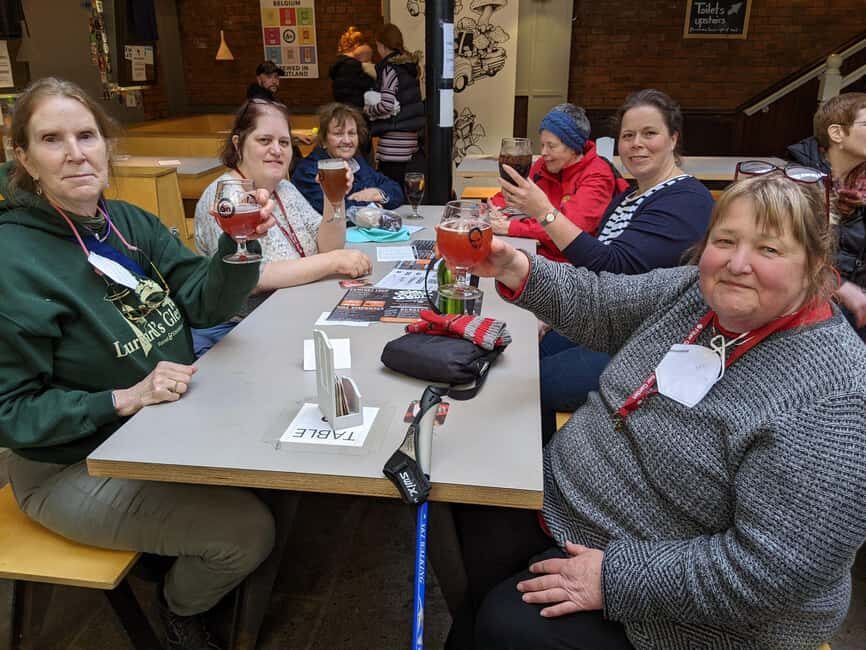
- Seven tasting stops built around Aberdeen classics like rowies, stovies (or soup), and oatcakes with Scottish cheese.
- Harbour-to-city center route that starts at the maritime side and ends in one of Aberdeen’s oldest townhouses.
- Murals and historic quarters in the Green and Merchant Quarter, including striking NuArt art.
- Landmarks in layers: Wallace Monument area, triple church spire views, and Victorian-era planning.
- A small group of 10 that keeps the pace friendly at a relaxed speed.
- Dietary flexibility: vegetarian/vegan options at most stops, with allergies handled if you email at least 48 hours ahead.
Why a food-led walking tour fits Aberdeen so well
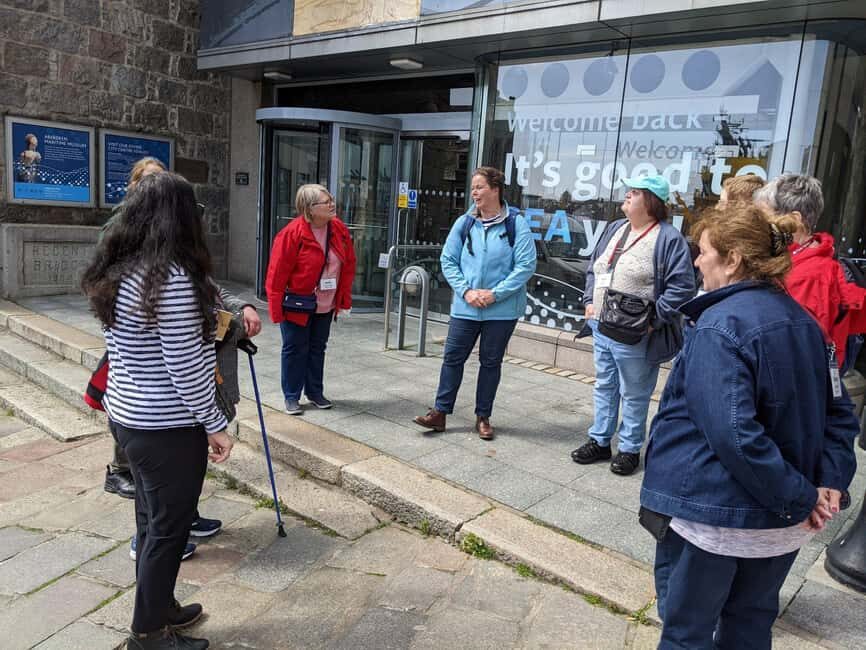
Aberdeen’s charm is partly its food culture and partly its geology-and-stone feel. This tour leans into both. Instead of dumping a list of landmarks on you, it uses what locals actually eat and drink to explain how the city worked—fishing, brewing, milling, and markets.
You’ll also get more than a straight sightseeing grind. You’re walking through working neighborhoods and historic corners that still look like the past left fingerprints. That matters because Aberdeen can feel understated if you rush. A guided route helps you slow down in the right places.
And yes, the tastings are the point. You’re guided from one moment to the next—sea heritage, medieval trade, grain and milling, market culture, then a sweet finish—so it all clicks instead of feeling like five unrelated stops.
You can also read our reviews of more walking tours in Aberdeen


Getting your bearings: harbour heritage and the Maritime Museum start
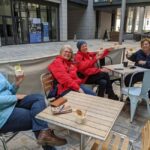
You meet left of the main entrance in front of the statue of a fisherwoman & fisherman. From there, the tour kicks off where Aberdeen’s identity makes sense: the harbour area, with the Maritime Museum as your anchor.
This first stop sets the tone by framing Aberdeen’s fishing heritage and shipbuilding past. It’s the kind of context that turns a waterfront walk into something more meaningful. You can almost picture smokehouses, fish markets, and granaries along the shoreline instead of just seeing modern buildings.
Then you get the first comfort-food hit: a classic buttery (rowie) with marmalade. It’s not just tasty; it’s a local-style pastry that matches the idea of hearty, practical food—meant for people who worked long shifts and needed something portable.
If you’re someone who normally skips museum talk but loves food, this start works well. It’s just enough background to make the rest of the route feel connected.
The Green and Merchant Quarter: murals, brewing women, and a market-town feel
Next you head toward The Green and the Merchant Quarter, an area tied to medieval Aberdeen and the daily rhythm of trade. The tour focuses on the women brewers—often called brewsters—who handled brewing as a domestic skill before industrialization changed the game.
This is where the walk starts to feel like a story you can see. You’ll move through older streets and then notice how the city reuses space over time. The guide also points out the modern creative layer, including bold NuArt murals, so you get the before-and-after view in the same neighborhood.
Food-wise, the tour keeps pointing back to what Aberdeen produced and sold. Even before you taste the next drink, you understand why brewing and local ales mattered here—especially when the city relied on grains and trades that supported everyday life.
Practical note: this section is visually fun. Take your time around the murals and side streets, because this is the part where you’ll likely want photos.
Union Terrace Gardens and the Wallace Monument area
From the Merchant Quarter, you shift to a more monumental part of town: Union Terrace Gardens, near the Wallace Monument. The tour pauses there to frame Aberdeen’s layers—how the city’s power came from mills, grain, and textile work as well as from the sea.
You also get a clear view of the architectural mix around you. The guide highlights the Triple Kirks spire and other major landmarks in the Victorian vision of the city, including St. Mark’s Church, His Majesty’s Theatre, and the Central Library. Even if you’re not an architecture fanatic, these details make sense when the tour links them to the city’s economic drivers.
And then there’s the small-but-smart tasting moment: you’ll toast with Irn-Bru in the gardens. It’s a quick stop, but it makes the pause feel intentional rather than rushed. Plus, it’s a fun local touch—one of those flavors that instantly says Scotland without requiring you to be a beer person.
If the weather turns, Union Terrace Gardens can still be a good pause zone. You’re outdoors, but it’s the kind of landmark area where you can regroup and refocus for the next stretch.
Marischal College: oats, cheese, and why grains matter in Aberdeen
The tour moves toward Marischal College, where the stonework makes a strong first impression. The guide uses that granite façade to talk about Aberdeen’s grain connection and why oats became such a big part of Scottish life.
You’ll learn how oats show up across everyday food—porridge, bannocks, oatcakes—and then you actually taste the pairing: oatcakes with Scottish cheese. It’s one of the tastings that feels both simple and deeply rooted. Cold, firm, and filling—oatcakes don’t pretend to be fancy, and that’s part of the appeal.
This is also a great moment if you want the tour to feel more than food. The guide discusses Robert the Bruce’s support for Aberdeen in conflict, along with how the city gave back. That kind of story helps explain why places matter, not just why they look good on a postcard.
One more tip: if your guide is the kind who points out hidden details (and some guides are very good at this), Marischal College is where the explanations can get especially vivid. The building’s significance isn’t just what you see from the front.





Castlegate and Mercat Cross: markets, craft beer, and the trade center
Castlegate and Mercat Cross is the next big shift—back to the idea of a city built around buying, selling, and public announcements. The Mercat Cross historically marked the center of trade and proclamation, so the area gives you a sense of how Aberdeen organized daily life.
The tour talks about the market culture across centuries, then brings you to the present-day craft scene. You’ll enjoy a locally brewed beer here, with an option for a non-alcoholic alternative.
It’s a smart pairing: brewing wasn’t a novelty in Aberdeen—it was connected to local production and skilled work. Getting a drink in this place makes the explanation feel practical instead of academic.
Also, the guide highlights the wider Aberdeenshire legacy in brewing and distilling, which helps if you’ve only heard about Scotland’s whisky in general terms. You come away with a better sense that fermentation and grain-based trades have long roots here, not just in the Highlands.
Provost Skene’s House: finishing strong with ice cream and a townhouse setting
You end in a quieter, historic way at Provost Skene’s House, one of Aberdeen’s oldest surviving townhouses. The stop shifts from the city as a trading machine to the city as a place shaped by specific people—local figures who influenced the wider world.
Nearby streets like Guest Row and Ragg’s Lane also come into the story, with the idea of shops and bakers that once fed the city center. It’s a nice reminder that a food tour isn’t only about meals; it’s about supply chains and daily shop life too.
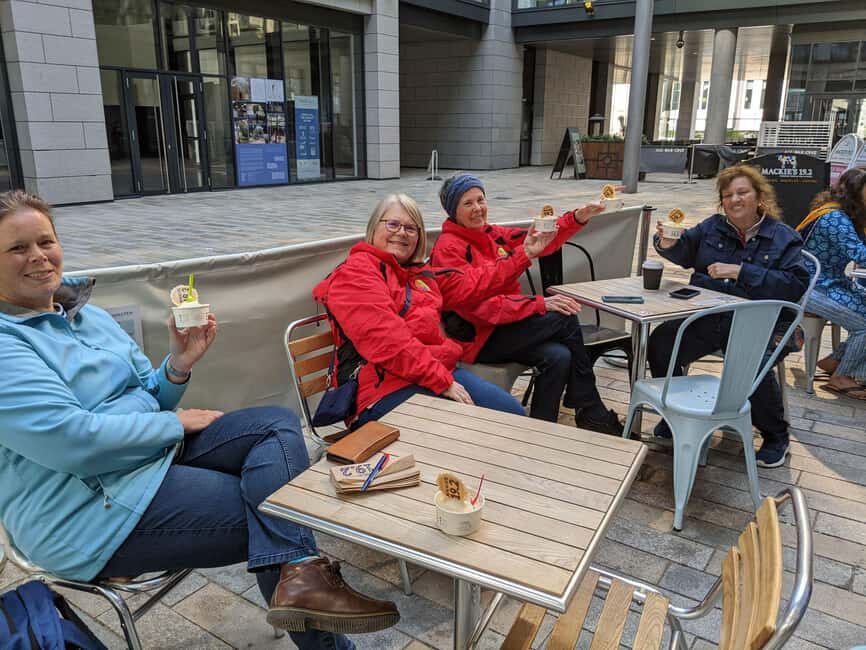
Then you get the payoff: Mackie’s ice cream, made in Aberdeenshire. It’s a creamy finish that feels like a proper end to four hours of savory tastings. If you’re the type who likes dessert to feel special, this hits the mark because it’s local rather than generic.
For pacing, I like this ending because it doesn’t require you to squeeze in one more activity. You’re done walking, fed, and in a spot that feels historically grounded.
What you’ll eat and drink on the route (plus smart questions to ask)
The tour is built around seven tasting stops, with a few extra nibbles and surprises along the way. Based on the described tastings, expect classics such as:
- traditional buttery rowies with marmalade
- a toast with Irn-Bru
- oatcakes and Scottish cheese
- a refreshing locally brewed beer (or non-alcoholic alternative)
- Mackie’s ice cream
- traditional stovies or a warming soup with crusty bread
Vegetarian and vegan options are available at most stops. If you have food allergies or specific dietary needs, the key is timing: you need to advise the operator at least 48 hours in advance so the guide can plan.
My practical advice: when you meet your guide, ask two things early. First, ask what you can swap if you avoid certain ingredients. Second, ask which tastings are the most filling, so you can time how much you pace yourself. With seven stops, you’ll want to spread your appetite, not race it.
The walking reality check: 3.5 km, cobbles, and road crossings
This is a relaxed-pace city walk, about 3.5 to 4 hours total. The route covers around 3.5 km (just over 2 miles), which is manageable for many people—but Aberdeen’s streets include cobbled sections, uneven surfaces, and moderate inclines.
You’ll also cross roads at various points. That sounds basic, but it’s exactly where a guide’s lead matters, especially if you’re focused on taste stops and side streets.
Weather matters in Aberdeen. The tour notes unpredictable conditions, so pack layers and plan on comfortable walking shoes that can handle uneven ground. If your shoes are the wrong kind, this stops being a food tour and turns into a foot-not-fun tour.
Group size also matters. With a max of 10 participants, it’s easier to keep together at slower intervals, especially near tasting stops.
Price and value: why $114 often makes sense here
At $114 per person, this isn’t a bargain snack crawl. But it’s also not only paying for food. You’re paying for a guided walk through historic Aberdeen plus seven structured tastings.
Here’s the value logic I see:
- Multiple paid-for tastings (rowies, oatcakes with cheese, a beer, dessert, and a hot comfort-food option)
- A route designed to connect food with specific places and stories
- A small group size, which helps you get real explanations instead of a rushed herd experience
- A 4-hour time window that’s long enough to feel like you saw a lot, but not so long you burn out
If you were trying to recreate this on your own, you’d spend time figuring out where to eat the right local classics and where those foods connect to the city’s history. The tour does that work for you and gives you context while you eat.
So the big question isn’t whether the price is high. It’s whether you want guidance and a built-in plan. If you do, the cost becomes easier to justify.
Who this tour suits best (and who should consider alternatives)
This tour is listed as not suitable for children under 16, and it’s also marked as not suitable for people with mobility impairments. That’s mainly because the route includes uneven and cobbled streets plus moderate inclines.
It does say the tour is wheelchair accessible, but the terrain notes still matter. If you’re using mobility aids, check your comfort with cobblestones and inclines before you book.
Who will enjoy it most:
- Adults who like food AND stories, not just one or the other
- Travelers who want a guided route through central Aberdeen without planning each stop
- People who appreciate local favorites like rowies, stovies, oats, and Mackie’s ice cream
- Anyone who prefers small groups (up to 10) and time to ask questions
If you’re the kind of traveler who gets bored with architecture talk, you can still get value here because the architectural context is tied to why food and trades mattered.
Should you book this Aberdeen walking and food tour?
If you want Aberdeen in one afternoon—sea-side beginnings, medieval trade corners, grain-and-milling stories, and a dessert finish—this tour is a strong match. The format works especially well when you like your sightseeing with real taste markers.
Book it if:
- you’re excited about local classics (not just generic pubs)
- you want a guide who points out smaller streets and architectural details
- you’ll enjoy a plan with structured stops rather than figuring it out yourself
Skip or reconsider if:
- cobbled streets and road crossings feel stressful
- you need a fully step-free route throughout
- you dislike walking for 3.5 km even at a relaxed pace
When in doubt, I’d choose it if you’re doing Aberdeen for a short stay. It’s the kind of tour that gives you a better sense of the city faster, and it feeds you along the way.
FAQ
How long is the Aberdeen City Walking and Food Tour?
It lasts about 3.5 to 4 hours, depending on the start time and walking pace.
What food and drink tastings are included?
The tour includes seven tasting stops, such as buttery rowies with marmalade, a toast with Irn-Bru, oatcakes with Scottish cheese, locally brewed beer (or non-alcoholic alternative), Mackie’s ice cream, and traditional stovies or a warming soup with crusty bread, plus a few extra nibbles.
Do you offer vegetarian or vegan options?
Yes. Vegetarian and vegan options are available at most stops. If you have allergies or specific dietary needs, you should advise the provider at least 48 hours before the tour.
Where do I meet the guide?
Meet to the left of the main entrance, in front of the statue of a fisherwoman & fisherman.
How much walking is involved, and what’s the terrain like?
You’ll walk around 3.5 km (just over 2 miles) at a relaxed pace. The route includes some cobbled streets, uneven surfaces, and moderate inclines, with road crossings throughout.
Is the tour suitable for kids or for people with mobility impairments?
It’s not suitable for children under 16. It’s listed as wheelchair accessible, but it also notes it is not suitable for people with mobility impairments due to the route conditions.