REVIEW · ABERDEEN
Aberdeen: Guided Walking Tour
Book on GetYourGuide →Operated by Boti Boti · Bookable on GetYourGuide
One city, one color theme, and a lot of stories. Aberdeen’s silvery-grey granite makes the buildings look almost sculpted, and a walking tour is the best way to see how the stones shaped the city. You also get a tidy mix of old and civic Aberdeen, from Old Aberdeen lanes to big university-and-college landmarks in the centre.
I like how the tour strings together the city’s main “why it matters” points. I also love that it’s not just street names: you’re guided through places like St. Machar’s Cathedral and Marischal College, then connected to the human stories around them.
One consideration: this is a proper walking tour. If you’re sensitive to long time on your feet or you fall into the activity’s stated “not suitable” categories, you’ll want to choose carefully before booking.
In This Review
- Key things you’ll notice on this Aberdeen walk
- Why Aberdeen’s granite feels like a character, not just a backdrop
- Meet at Castle Gate (Mercat Cross) and start with the right landmarks
- Old Aberdeen: cobbles, preserved lanes, and St Machar’s Cathedral
- King’s College energy and how Aberdeen’s scholars show up in stone
- Union Street to Marischal College: civic pride in the second-largest granite scale
- The Mither Kirk stop: why the Kirk of St Nicholas feels different
- The Art Gallery stop: where “modern Aberdeen” shows up
- Seaton Park along the River Don: the breathing space you’ll appreciate
- Nature and coastal walks: what the tour sets you up to explore next
- Price and value: is $94 per person fair for a 2-hour walk?
- Group feel, guide quality, and one thing to watch
- Practical rules and what to bring (so the walk stays pleasant)
- Who this walking tour suits best (and who should reconsider)
- Should you book the Aberdeen Guided Walking Tour?
Key things you’ll notice on this Aberdeen walk

- Granite architecture that looks different at every turn on Union Street and around the colleges
- Old Aberdeen in 15th-century mode, with cobbles and a preserved feel
- Big landmark energy in a short time, from Marischal College to the Mither Kirk
- Cathedral and university stops that give you context, not just photos
- Riverside breathing room at Seaton Park along the River Don
- Guide support in multiple languages, including English, Russian, Turkish, and Kazakh
Why Aberdeen’s granite feels like a character, not just a backdrop

Aberdeen is one of those places where the buildings don’t fade into the background. The city’s granite gives the streets a specific mood: cool tones, sharp edges, and a kind of calm permanence. Walking makes it click. When you move slowly, you start noticing details that you’d miss from a bus window, like how different blocks of stone catch the light and how whole rows of buildings share the same material logic.
I also appreciate the tour’s “north Scotland” mix of themes. You’re looking at university life, medieval faith, and civic pride, all in one connected route. That matters because Aberdeen’s identity isn’t only maritime, even though the sea and waterways are part of the story. The city’s granite and institutions show the other half: education, religion, and local ambition.
If you like learning while you walk, you’ll probably enjoy the pace. The best tours here don’t rush the photos. They help you understand what you’re seeing, so your camera stops being the main event.
You can also read our reviews of more walking tours in Aberdeen


Meet at Castle Gate (Mercat Cross) and start with the right landmarks
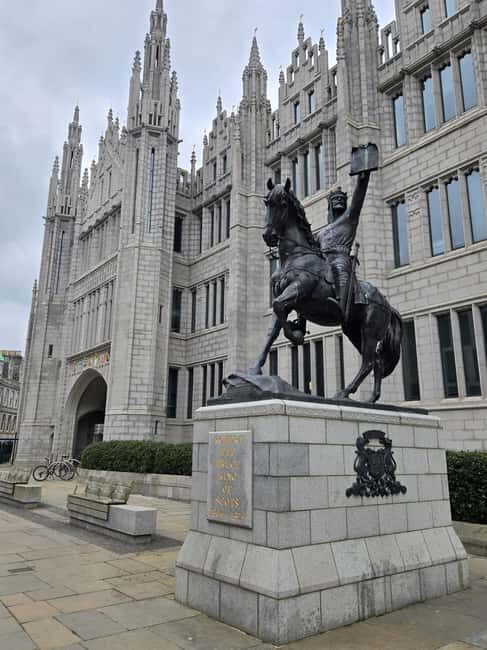
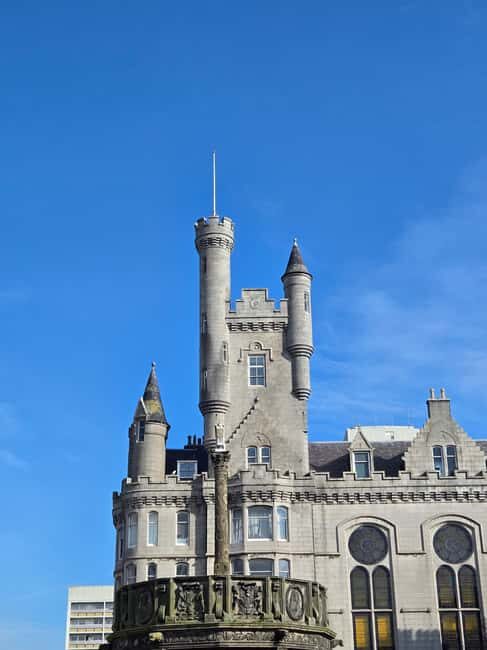
Your tour starts at Castle gate (Mercat cross). That matters because it’s a central “anchor” point. From there, you can connect what you’ll see later with where you started. It’s also practical: you’re not wandering across the city hunting for a meeting point.
Once your booking is confirmed, you’re provided a photo of the meeting point and you can use that to get your bearings quickly. Do yourself a favor and arrive a few minutes early. In a one-thing-goes-wrong city like any other, early arrival gives you a buffer if the timing slips.
This tour runs for 2 hours, so you’ll want to keep your group energy smooth. Wear shoes you can walk in for that long. And bring your camera, because Aberdeen’s stone and street angles give you plenty of shots even if the sky is grey.
Old Aberdeen: cobbles, preserved lanes, and St Machar’s Cathedral
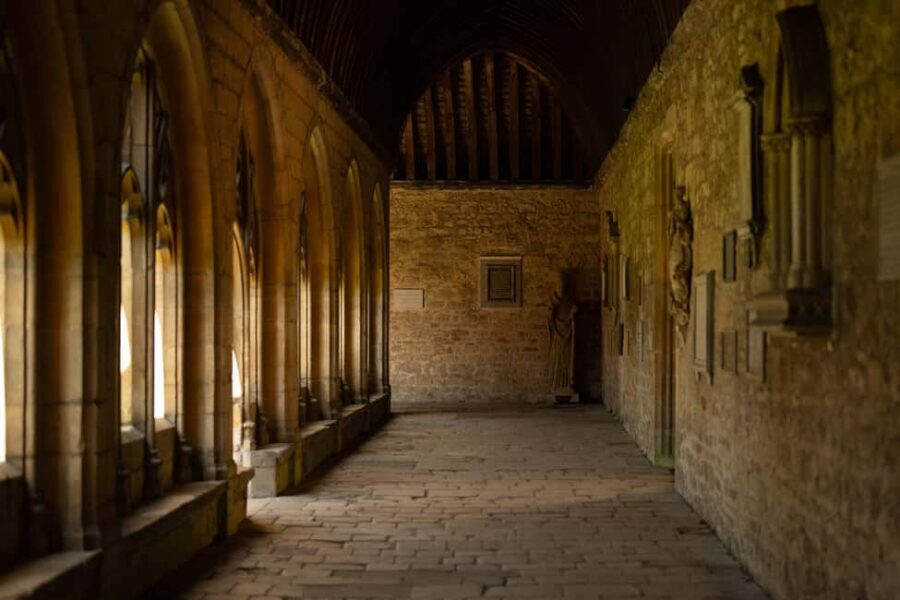
Old Aberdeen is the part that can feel like stepping into a different pace. You’re walking through a preserved quarter that dates back over 700 years, with cobbled streets and 15th-century building character. It’s not just old-looking. It feels old in how the streets compress and slow you down. That’s the advantage of doing it with a guide: they help you read the city’s layers instead of treating it like a postcard set.
A highlight here is St. Machar’s Cathedral. The tour’s framing emphasizes it as a medieval church with stained glass and an atmosphere of quiet reverence. Even if you’ve seen cathedrals before, the appeal is that you’re not far from the rest of the story. You’re seeing how the cathedral fits into the wider university-and-church web of the area.
Then you move through the Old Aberdeen “education gravity” with a stop at King’s College, founded in 1495. That date isn’t trivia. It’s a way to understand why so many of Aberdeen’s key buildings feel like they belong together. If you’re the kind of traveler who likes to connect places to time, this stop will likely be one of your favorites.
One practical note: Old Aberdeen streets can feel tight and uneven. You’ll get the romance, but you also get real walking surfaces. Comfortable shoes are not optional here.
King’s College energy and how Aberdeen’s scholars show up in stone
King’s College is one of those stops that clicks if you care about how cities evolve. A university founded in 1495 means Aberdeen wasn’t waiting around for modern development to create identity. It had institutions early, and those institutions left physical marks.
As you approach and pause, the guide’s job is to connect what you see to what those institutions meant for daily life. In practice, that means you’ll likely hear stories tied to scholars, saints, and Scottish royalty. Even if you don’t remember every detail, you’ll come away with a clearer sense of why these buildings aren’t random highlights.
If you’re an architecture person, this is also where you can start comparing styles. Granite unifies the city, but you still see differences in shape, massing, and ornament depending on whether a place is religious, academic, or civic. Walking between these stops helps you build that mental map.
The tour also gives you that useful travel skill: learning to look. Once you train your eye on stone texture and building form, other parts of Aberdeen start making sense on your own after the tour ends.
Union Street to Marischal College: civic pride in the second-largest granite scale
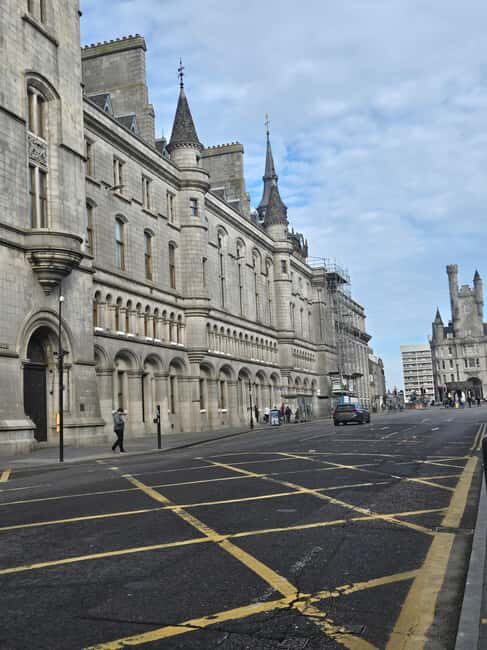
After Old Aberdeen, you transition into the city centre. The route includes Union Street, Aberdeen’s main artery, known for elegant granite buildings, plus shops and cafés along the way. This is a good stretch because it lets you reset your pace. You’re still walking and still learning, but it feels less enclosed than the older lanes.
Then comes Marischal College. The tour highlights it as the second-largest granite building in the world, and that claim is easy to grasp once you’re there. Big buildings like this don’t just look impressive. They communicate civic confidence. You can almost feel the city saying we’re not a small town. We’re a centre.
This is where a good guide earns their fee. Instead of just pointing at granite, the guide typically explains why a place like Marischal College became a symbol. You also get local context about how Aberdeen’s pride is tied to institutions and public life.
If you’re traveling with someone who likes photos but also wants meaning, Marischal College is a strong stop. You get both: a dramatic structure and the story behind it.





The Mither Kirk stop: why the Kirk of St Nicholas feels different
Next on the list is The Kirk of St Nicholas, also known as the Mither Kirk. The tour describes it as one of the oldest churches in the city and steeped in local lore. That combination matters. You’re not just looking at another historic building. You’re stepping into a site that local culture treats as part of daily memory.
When you walk up to older churches, you can sense how they anchor a neighbourhood. This one seems especially tuned to that role because the nickname Mither Kirk signals how people related to it emotionally. If you like places that feel woven into local identity, this is a highlight.
A drawback to expect: you may want a bit of quiet time here. If the group is moving quickly or you’re pressed for photo angles, it can feel rushed. Still, having a guide helps because you’re not guessing what you’re looking at.
The Art Gallery stop: where “modern Aberdeen” shows up
The tour includes a visit to the Art Gallery, recently refurbished. The emphasis is that you’ll see everything from Victorian masterpieces to more cutting-edge contemporary work.
This stop is a smart break in the route. Up to now, you’ve mostly been in religious and institutional spaces tied to old foundations. An art gallery gives you another kind of local identity: how Aberdeen expresses itself now.
One thing to plan: if you’re an art person, you may want to spend a little longer than the time the group allows. But even a short guided visit can help you decide what to look for quickly—especially if you’re not familiar with Scottish art timelines.
If you’re not an art fan, don’t panic. The gallery stop works best as a cultural palate cleanser. It’s also close enough to the rest of the route that you don’t lose the flow of the day.
Seaton Park along the River Don: the breathing space you’ll appreciate

Seaton Park is included, and the tour points out it’s an expansive green space along the River Don with views and peaceful walking paths. This is a key part of why the tour doesn’t feel like a nonstop sprint between buildings.
A riverside pause is useful in real travel terms. It gives you a chance to catch your breath, reset your phone battery for photos, and loosen your legs before the next section. It also helps you remember Aberdeen isn’t only stone. The water systems around the city matter to how people live and move.
This is also where you’ll likely feel the practical side of “guided walking.” Instead of skipping ahead to the next big landmark, you get breaks at meaningful moments. You come away less exhausted and more satisfied.
Nature and coastal walks: what the tour sets you up to explore next
The tour package mentions nature and coastal walks, and it specifically frames routes like Aberdeen Beach to Donmouth Nature Reserve as ideal for nature lovers. Even if you don’t cover a whole coastal section during your 2 hours, the value here is guidance: you leave with clear ideas for where to go next once the guided portion ends.
That’s the kind of travel help that works. You’re in Aberdeen. You want a walk. You don’t want to spend the afternoon Googling possible paths. A guide pointing you toward the right kind of coastal-river route saves time and frustration.
If weather changes your plans, these coastal/riverside suggestions are flexible. Grey skies are common here, and a well-chosen riverside route can still feel great even when the sea air is chilly.
Price and value: is $94 per person fair for a 2-hour walk?
At $94 per person for 2 hours, this isn’t a bargain-basement stroll. It is closer to “you’re paying for focused guidance” than “you’re paying for access to a place.” You do get that focus: cathedral, university stops, the city centre highlights, plus a gallery visit and a green space.
So the value question comes down to what you need from the experience. If you love independent wandering, you can probably see a lot of Aberdeen for free. But if you want someone to connect the dots between the architecture and the stories behind it, this tour is priced like that.
I also think the private group setup changes the math. A private group means you’re not fighting for attention among strangers. That usually makes explanations clearer and photo moments less chaotic. It’s not just convenience. It affects how much you actually remember.
For me, the best sign of value is when a tour covers major landmarks and gives context so those landmarks don’t feel like name tags. This one aims directly at that.
Group feel, guide quality, and one thing to watch
The tour is a private group and includes a live guide. Languages listed include English, Russian, Turkish, and Kazakh. In practice, this matters if you’re traveling with someone who prefers a specific language. You’ll likely feel the tour get smoother when the guide can explain in a language you’re comfortable with.
The reviews you’ll find around this tour style highlight two themes that are worth your attention. First, people praise the tour as informative and easy to navigate, with a relaxed atmosphere. Second, there’s an example of a guide named Guli being flexible when the start time needed changing. That kind of real-world adaptability makes a guided walk feel less like a schedule trap and more like a plan that can breathe.
There is also a blunt caution: one experience notes the guide did not show up. That’s rare, but it’s the kind of thing you should plan for. Your best move is to confirm your timing ahead of time and show up at Castle gate (Mercat cross) with enough buffer that you can ask questions immediately if anything feels off.
Practical rules and what to bring (so the walk stays pleasant)
Here’s what I’d bring for this exact kind of city walk:
- Comfortable shoes (cobbles and uneven stone can be slow work)
- A camera
- Weather-appropriate clothing (Aberdeen weather has a habit of switching moods)
And here are the tour rules that can surprise people if you show up unprepared:
- Pets are not allowed.
- Audio recording isn’t allowed.
- Large bags and oversize luggage aren’t allowed.
- Smoking and lots of other items are restricted, including alcohol/drugs and fishing equipment.
If you hate rules, don’t worry. Most are there to keep the group moving and keep indoor stops from becoming a mess. Pack light and you’ll feel grateful halfway through.
Who this walking tour suits best (and who should reconsider)
This tour is geared toward people who enjoy history, architecture, and culture. It also works well if you like a guided route that hits both the old lanes and the civic core.
It also fits a “smart first day in Aberdeen” role. If you’re only here for a short trip, this gives you a quick, coherent overview: Old Aberdeen, the cathedral/university cluster, then the centre’s major stone landmarks, then a cultural stop, then a riverside break.
However, the activity notes include a list of people for whom it may not be suitable. If you have significant mobility needs, epilepsy, visual/hearing impairments, are under 12, or fall into the listed age/weight limits, you should treat this as a serious “check first” situation rather than a casual booking.
Also, if you’re looking for something kid-friendly, this is not a great fit for young children based on the age guidance given.
Should you book the Aberdeen Guided Walking Tour?
Book it if:
- You want Aberdeen’s granite architecture explained in a logical route.
- You’re excited by Old Aberdeen’s preserved lanes and the big institution buildings.
- You’d rather have context than just wander to landmarks.
- You like the idea of mixing stone stops with a riverside green pause at Seaton Park.
Skip it or rethink if:
- You dislike longer walking on mixed surfaces.
- Your needs fit the activity’s stated not-suitable categories.
- You’re worried about schedule reliability. If you book, confirm ahead and arrive early at Mercat cross so you’re not scrambling.
If you’re the kind of traveler who likes to understand a city’s bones, this one makes sense. In 2 hours you’ll see the key structures that define Aberdeen’s look and feel, and you’ll come away with a better sense of how those stones connect to people and time.