London’s oldest layers are right under your feet. This 140-minute City of London tour connects St Paul’s Cathedral and the Monument to the Great Fire with business-district surprises like Bank-area stops and a visit option to London Mithraem or the Guildhall. I especially like how the route keeps pairing headline landmarks with lesser-seen sites, and I also liked the energy from guide Nick, who clearly enjoys talking through what you’re looking at. The one catch: it’s a tight schedule, so you’ll move at a brisk pace rather than spend long stretches inside any single place.
If you like good “how did this place get like this?” storytelling, this tour is built for you. You’ll also get an entry included for a viewing platform at 120 the Garden, which adds a helpful perspective when you’re tracing the city’s layers of change. I’d consider it a strong choice if you want an efficient first taste of the City without feeling like you’re just collecting photos.
This is a live English tour with a wheelchair-accessible route, and it’s priced at $24 per person for the time and entries involved. It’s not suitable for babies under 1 year or people over 95 years, so check age fit if that applies.
In This Review
- Key things you’ll notice on this tour
- How this 140-minute City of London route works
- St Paul’s Cathedral: why it’s more than a photo stop
- The Monument to the Great Fire of London: the landmark that points to change
- Bank of England area: where Roman remains meet finance streets
- London Mithraem or the Guildhall: making history feel close
- Leadenhall Market: a historic market break in the middle of the big sights
- 120 the Garden viewing platform: why the view matters for this route
- Tower of London: ending with gravity and scale
- Price and value: is $24 fair for 140 minutes and entries?
- Who should book this tour (and who should skip it)
- Should you book this City of London tour?
- FAQ
- How long is the Hidden Gems Tour of the City of London?
- What’s included with the entry stops?
- Is the tour wheelchair accessible?
- What language is the tour guide?
- What is the cancellation policy?
- Who is the tour not suitable for?
Key things you’ll notice on this tour

- Icon-first, story-driven order: St Paul’s, the Great Fire Monument, Bank, Leadenhall Market, then the Tower area
- Included entry stops: London Mithraem or the Guildhall, plus a viewing platform at 120 the Garden
- Great guide energy: Nick’s passion shows in how he keeps you following the “why” behind each site
- Big history meets everyday London: banking streets, a historic market, and cathedral views in one run
- Fast pacing by design: 140 minutes means you’ll cover more ground than you can linger
How this 140-minute City of London route works
This tour is built as a quick chain of “you’re here” moments. In other words, you’re not just looking at famous buildings—you’re tying them to what came before. The story arc runs through the oldest parts of the City, starting with Roman-era remains and then moving forward into medieval and post-medieval London, including the Great Fire and the way the City rebuilt and reasserted itself.
At 140 minutes, you’ll cover a lot of walking and looking. That’s good if you’re short on time and want a structured introduction. It’s less ideal if you plan to spend a long time reading every wall plaque or if you’re the type who needs downtime. If you’re comfortable moving from stop to stop, this format makes sense.
Also, the guide is live and in English, so you can ask questions when something sparks your curiosity. That matters with a route like this, because the meaning behind the sights often depends on context—how a Roman site ended up near later streets, or why a fire monument became a must-see reference point.
You can also read our reviews of more city tours in London



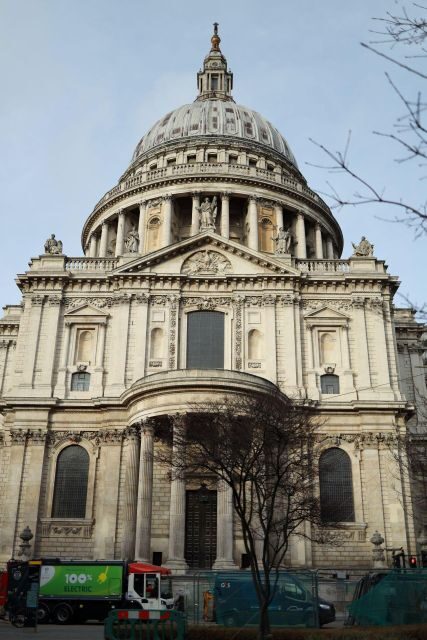
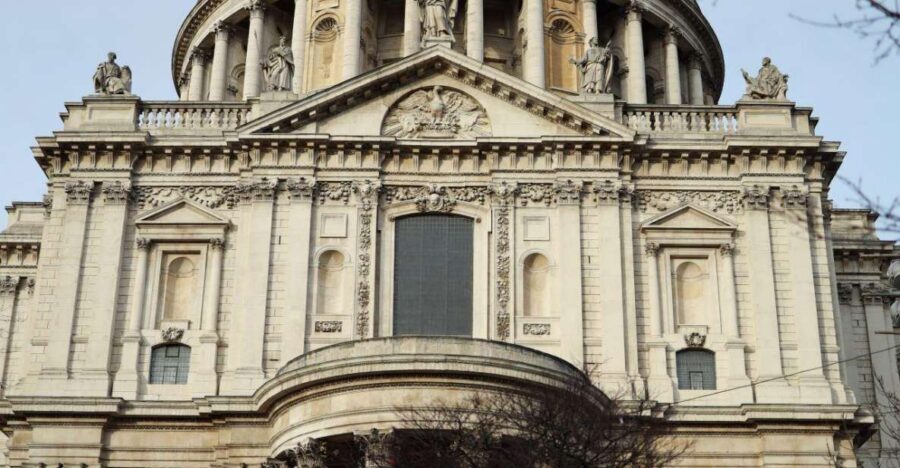
St Paul’s Cathedral: why it’s more than a photo stop

St Paul’s Cathedral is a flagship sight, but on this tour it’s treated like a “lens” for understanding the City. Seeing it early (as part of the route) helps because the cathedral sits in a place people link to London’s bigger turning points—religious power, rebuilding, and the City’s long memory.
What you’ll likely enjoy most is the way St Paul’s connects scale and symbolism. Even if you’ve seen it from the outside before, being guided to the right viewing angles changes how you read it. You’ll also get the sense of why this cathedral becomes a starting point for so many London stories: it’s an anchor you can compare against everything else you’ll see later, from the Great Fire Monument’s reminder of catastrophe to the practical intensity of the Bank area.
Possible drawback to plan around: if you’re hoping for lots of time inside St Paul’s specifically, the tour’s overall length may feel fast. This experience is designed for movement and orientation, not a slow museum day. If you want “deep inside” time, you can treat this stop as your orientation moment and then add extra self-guided time on your own later.
The Monument to the Great Fire of London: the landmark that points to change

The Monument is one of those London sights that works because it’s both dramatic and instructional. On this tour, it’s not just a tall structure in the skyline—it’s a built reminder of what happens when the City suffers a major reset, and then decides how to rebuild.
If you pay attention to what your guide connects here, you’ll understand why the Great Fire kept showing up in later planning and thinking. You’re essentially watching the City’s survival instinct turn into long-term memory. The Monument gives you a physical landmark for a historical event that shaped everything that followed.
What makes this stop especially valuable is that it gives your later visits sharper meaning. When you then head toward the Bank and the Tower area, you’ll be reading the City with a “rebuilding and resilience” mindset rather than seeing it as only a collection of old buildings.
Drawback to consider: this is a stop that rewards quick attention. Don’t expect to stroll slowly and analyze every detail if the group is moving on soon. If you want longer reflection time, you can always return later, but for this 140-minute plan, your best bet is to stay present and listen.
Bank of England area: where Roman remains meet finance streets
The tour’s Bank-area time is where the City feels like a layer cake. You’ll be in the part of London that’s heavily associated with modern finance, but your tour also includes an entry option tied to earlier history—London Mithraem or the Guildhall.
That’s a big part of the value here: you’re not treating history as something “over there.” You’re seeing it embedded in the same geography as today’s major institutions. The included entry helps you make the jump from street-level views to something more tangible.
Here’s what I think makes this portion work for most visitors:
- You get a mental switch: from iconic architecture to “how the land was used.”
- You get a clearer feel for why Roman-era stories still matter in the City.
- You get at least one indoors/entry element to balance the outdoor landmark pace.
Possible consideration: you won’t get to “choose your own adventure” inside both London Mithraem and the Guildhall, because the tour includes one entry option. If you know one of these specifically is your top priority, you might want to check which option is scheduled for your departure time when you book.
London Mithraem or the Guildhall: making history feel close
The included entry to London Mithraem or the Guildhall is the kind of add-on that changes how your day feels. Outdoors, you’re scanning for shapes, angles, and skyline drama. Indoors, you slow down just enough to absorb details you can’t get from a passing glance.
London Mithraem connects you to the Roman world through remains that feel surprisingly close to street life. The Guildhall, on the other hand, brings a strong sense of the City’s civic and administrative story. Either way, the point is the same: the City’s power didn’t start in modern boardrooms. It’s been organizing itself—politically, socially, and economically—for a long time.
What I like about this included element is that it gives you something to remember that isn’t just “I saw a big building.” You get a specific experience attached to the route, which helps the rest of the walk click into place.
Drawback to plan for: if you’re someone who hates any kind of indoor exhibit time, this tour might feel a little more structured than you prefer. But if you enjoy short, guided context, that entry stop is one of the strongest parts of the schedule.





Leadenhall Market: a historic market break in the middle of the big sights

After the heavier symbolism of St Paul’s and the Great Fire Monument, Leadenhall Market brings a different mood. It’s the kind of stop that reminds you the City isn’t only about monuments and institutions—it’s also about daily life, commerce, and everyday movement through historic spaces.
What you’ll likely appreciate here is the contrast. By the time you reach Leadenhall Market, you’ve been building a story about long-term change. This stop helps you breathe for a moment and see how historic structures keep functioning as real parts of the city.
Also, markets are where you can pick up details with your eyes. You get texture. Color. The sense of place. Even if you just pause briefly, the market setting can make the rest of the tour feel more grounded.
Possible drawback: if you’re expecting a long shopping spree or long browsing time, this won’t be that. The tour is about coverage in 140 minutes, so treat this as a refresh and a photo-and-stroll moment rather than a full shopping destination.
120 the Garden viewing platform: why the view matters for this route
One of the included perks is entry to the viewing platform at 120 the Garden. This is a smart move in a tour like this because it gives you a “map in your brain.” When you’re standing in a high viewpoint position, streets and landmarks stop feeling random and start lining up.
For me, this is the step that helps the whole day stay coherent. You’ll have seen St Paul’s and the Monument, you’ve walked through the gravity of the Bank area, and you’ve reached the historic market. From a viewpoint, you can connect what you learned to how the City is laid out.
It’s also a good way to reduce effort later. After the tour, when you look at photos or pass by streets again, you’ll recognize the pattern—what’s near what, and why certain buildings feel like “anchors.”
Possible consideration: viewing platforms can have crowds depending on time. The data doesn’t say what crowd levels are like, so you should assume it might be a shared space with other visitors. If you’re sensitive to tight stairways or waiting, plan to be patient and keep moving with the group.
Tower of London: ending with gravity and scale
Ending (or near-ending) at the Tower of London gives the day its final weight. The Tower is the kind of landmark that feels instantly important, even if you’re not a history specialist. On this tour, it works best as a capstone: you started with Roman remains and big civic memory, and now you finish with one of the City’s most dramatic symbols of power.
Even if you don’t go deep into every detail during the time you’re there, the Tower’s scale changes how the rest of the day reads. It becomes easier to imagine the City as a place that repeatedly invested in fortification, governance, and control—then kept evolving.
Possible drawback: the Tower is so famous that it can feel like you’ve “been there” even when you haven’t. Use the guided part of the tour to focus on what connects it to the rest of the route—especially the idea of the City reasserting itself after major turning points. If you just treat it as a generic tourist stop, you’ll miss what makes the tour stronger.
Price and value: is $24 fair for 140 minutes and entries?
At $24 per person for a 140-minute guided tour, the value depends on two things: (1) what you’d pay separately for similar entry experiences, and (2) how much you care about having someone connect the dots.
You’re not only doing landmark sightseeing. You also get included entry to London Mithraem or the Guildhall, plus entry to the viewing platform at 120 the Garden. Those two components alone make the tour more than a simple walking route.
Compared to paying for individual admissions on your own while also trying to coordinate timings, this is a tidy way to save effort. You spend a single chunk of time moving through a concentrated set of sites instead of piecing together an itinerary with multiple tickets and time slots.
The main thing to watch is your own preferences:
- If you want a quick orientation plus at least one meaningful entry stop, this price makes sense.
- If you want long, self-guided time at each major attraction, you might feel the schedule is too compressed for the Tower or St Paul’s.
Who should book this tour (and who should skip it)
This tour is a good fit if you:
- want a structured introduction to the City of London’s major landmarks
- like guided context that helps famous buildings make sense
- enjoy short entry experiences more than full-day museum wandering
- care about seeing both iconic sights and smaller, story-heavy stops like Leadenhall Market and the Bank-area options
Skip or think twice if you:
- need lots of time in each building and hate moving on quickly
- dislike indoor exhibit or entry-style components
- are traveling with someone who doesn’t meet the stated age guidance (under 1 year or over 95 years)
One more practical note: it’s wheelchair accessible, which is a big plus for mobility planning. The route is designed to be workable, but you’ll still be walking as part of a 140-minute tour, so wear shoes you trust.
Should you book this City of London tour?
I think this is a smart booking if you want a compact, guided route that links London’s big names with included entry stops. It’s priced reasonably for the mix of landmarks and admissions, and the guide energy—especially Nick’s passion for the route—seems to be a major reason people rate it highly.
Book it if you’re in London for a short stay or you want an organized first pass through the City. Skip it if your idea of the perfect day is unhurried time inside each major attraction. For most visitors, though, this is exactly the kind of plan that helps you leave with more understanding than just photos.
FAQ
How long is the Hidden Gems Tour of the City of London?
The tour lasts 140 minutes.
What’s included with the entry stops?
The tour includes entry to London Mithraem or the Guildhall, and entry to the viewing platform of 120 the Garden.
Is the tour wheelchair accessible?
Yes, the tour is listed as wheelchair accessible.
What language is the tour guide?
The live tour guide speaks English.
What is the cancellation policy?
Free cancellation is available up to 24 hours in advance for a full refund.
Who is the tour not suitable for?
The tour is not suitable for babies under 1 year and for people over 95 years.