REVIEW · BRISTOL
St Mary Redcliffe Church Bristol: Guided Tour
Book on GetYourGuide →Operated by St Mary Redcliffe PCC · Bookable on GetYourGuide
Bristol’s best church secret is how much fits in. St Mary Redcliffe is a medieval powerhouse built across centuries, and the tour spotlights medieval graffiti you’d miss on a regular visit plus the Chatterton Room tucked high above the North Porch. The one real catch is the Chatterton Room needs a 75-step spiral staircase, so it’s not suitable for everyone.
I like that the guide starts strong and keeps momentum: you begin at the hexagonal North Porch, once the main chapel with a shrine to the Virgin Mary, and you work your way through the most interesting architecture in a tight 90 minutes. If you only have a short window in Bristol, this is a smart way to see what makes this church famous without wandering around lost.
You’ll also get the wow-factor items in sensible order: sea-linked Bristol history (including John Cabot’s voyage connection), standout stained glass, and the famous view back toward the chancel under a vaulted ceiling lined with roof bosses. Most of the church is accessible via the south entrance on a level, but the hidden-room part is where accessibility can change your plans.
In This Review
- Key highlights you’ll feel right away
- Why St Mary Redcliffe turns a church visit into a story
- Starting at the North Porch: the hexagon that sets the tone
- The sea connections: Cabot’s whalebone and Bristol trade power
- Inside the main body: west end views, roof bosses, and perpendicular Gothic
- St John’s Chapel stained glass: the color that still survives
- North Transept and the mysterious effigy
- The Lady Chapel: Harry Stammers stained glass and a gothic screen
- South Transept tombs and the spire that fell
- Medieval graffiti and merchants’ marks you can finally see
- The Chatterton Room: a hidden upper space worth planning for
- Price and timing: $8 for 90 minutes that feel earned
- Who should book this St Mary Redcliffe church tour
- Should you book this guided tour of St Mary Redcliffe?
- FAQ
- FAQ
- How long is the St Mary Redcliffe guided tour?
- How much does the tour cost?
- Where do I meet the guide?
- What areas of the church are normally closed that this tour accesses?
- Is the Chatterton Room accessible for people who can’t climb stairs?
- Is the tour offered in English?
- Is there a way to keep plans flexible with booking and cancellation?
Key highlights you’ll feel right away
- North Porch focus: start in the hexagonal C12–C13 space with shrine history and mysterious exterior carvings
- Medieval graffiti and marks: merchant marks and wall scribbles that have been sitting there for centuries
- Stained glass in two settings: C14 glass in St John’s Chapel plus later work in the Lady Chapel by Harry Stammers
- A church shaped by Bristol’s wealth and trade: Cabot connections and tombs tied to merchant princes
- Perpendicular Gothic architecture details: roof bosses and soaring pillars that look better the closer you get
- Chatterton Room access above the porch: a memorable add-on for those who can climb the stairs
Why St Mary Redcliffe turns a church visit into a story
St Mary Redcliffe is one of those Bristol landmarks where you can feel the layers even before you hear a single fact. The building spans from the 12th through the 19th century, and the tour does a good job of turning architecture into narrative: why things were built, who paid for them, and what changed after disasters and new generations took over.
The value for money is also unusually strong. For about $8 per person and 90 minutes, you get access to areas that are normally closed, plus guided context that makes the carvings, tombs, stained glass, and monuments click into place. It’s not just sightseeing; it’s a guided reading of the building in plain language.
You’ll likely appreciate this most if you enjoy details: the kind of traveler who stops when they see old stonework, wants to know who the people were behind the monuments, and likes when a guide answers questions instead of rushing to the finish.
You can also read our reviews of more guided tours in Bristol



Starting at the North Porch: the hexagon that sets the tone
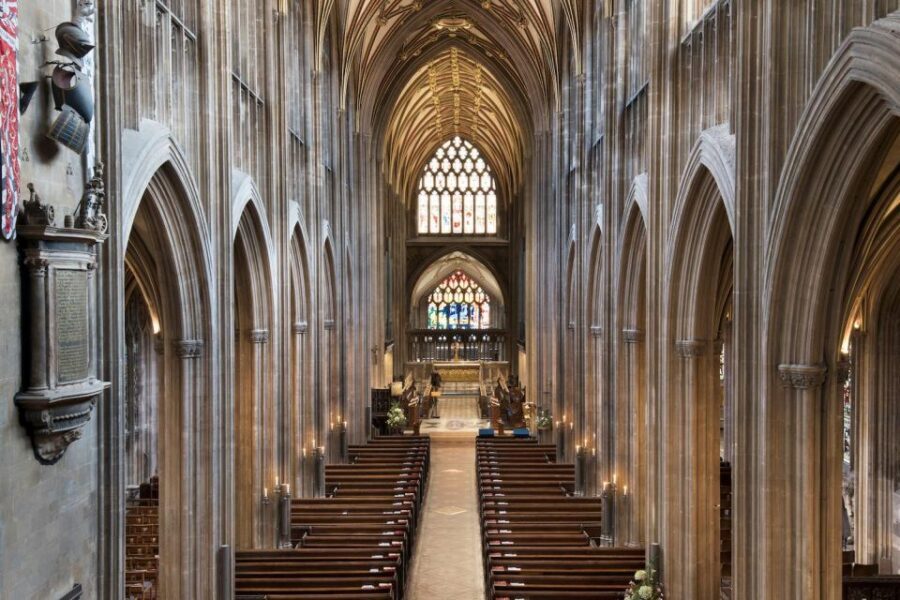
Most tours in big churches start somewhere easy. This one begins at the hexagonal North Porch, which is already a mini-world of history.
Here’s what makes it the perfect opening stop. The porch dates to the C12–C13 and was once the church’s main chapel. It even held a shrine to the Virgin Mary, so you’re not just looking at an entrance area—you’re stepping into a space that once had a purpose beyond movement in and out.
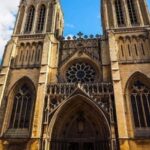
From there, you’ll head to the outside to look at the stone carvings on the porch exterior. The carvings are described as both exquisite and mysterious, and that mystery matters: standing close helps you spot the visual rhythm of medieval workmanship—figures, patterns, and details meant to be read slowly. It’s an easy place to slow down without holding up the rest of the tour.
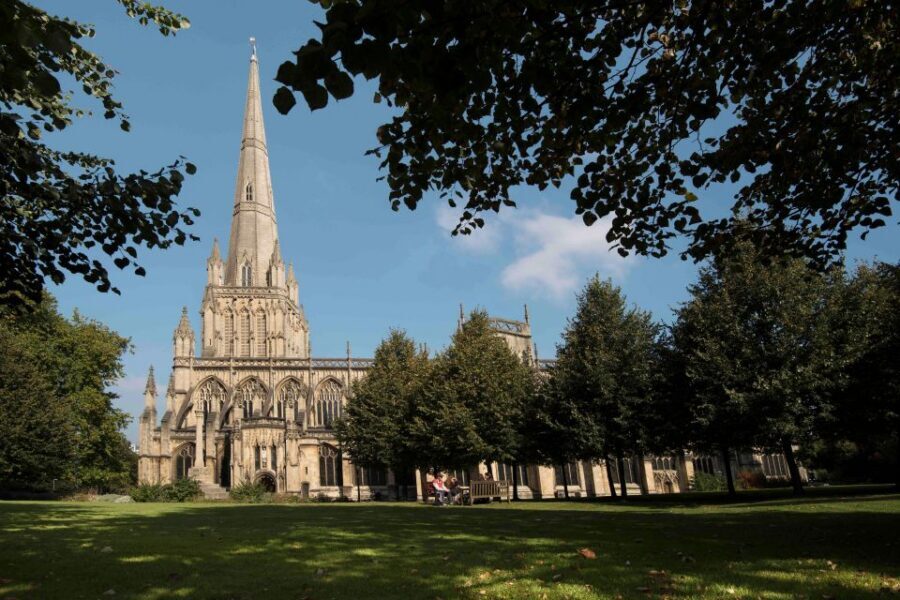
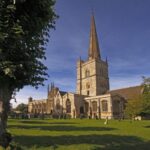
Finally, you get a solid chance to take in the famous tower and spire. You’ll understand the church better if you can connect what you see outside with what you’ll see inside next.
The sea connections: Cabot’s whalebone and Bristol trade power
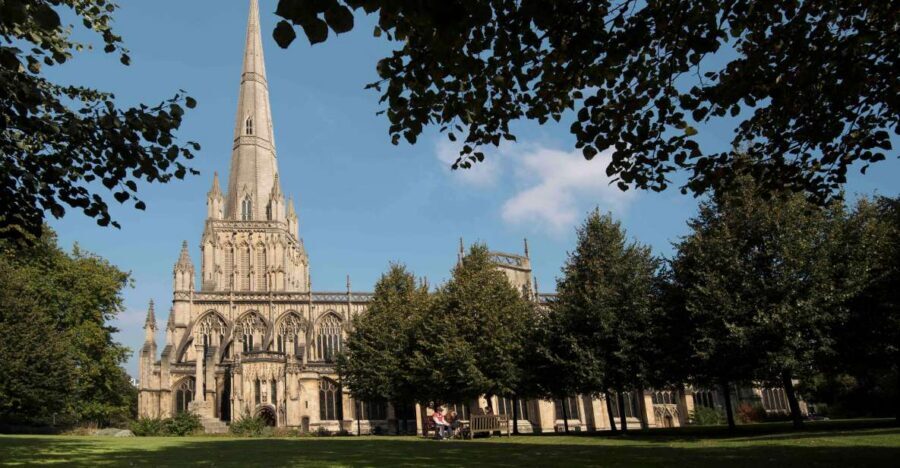
One reason St Mary Redcliffe feels different from smaller local churches is how it ties into Bristol’s global reach. The tour highlights the church’s maritime connections, especially around John Cabot and his 1497 voyage.
A key stop is the representation connected to Cabot’s trip: a C15th whalebone linked to his voyage on the Matthew. Above the main entrance, you can see a model of the Matthew, which gives the connection a visual anchor. Even if you’re not a deep maritime-history person, this kind of concrete artifact connection makes the story easier to remember.
After that, the guide shifts you toward the people who built and rebuilt the church: Bristol merchants with real influence. You’ll hear about the wealthy merchant princes and how their money shaped the church’s future, which is important context because so much of the interior you’ll see later depends on later generations maintaining and upgrading the building.
This is where the tour’s pacing pays off. You don’t just get random facts. You get a sense of Bristol as a trading city, and the church as part of that network.
Inside the main body: west end views, roof bosses, and perpendicular Gothic
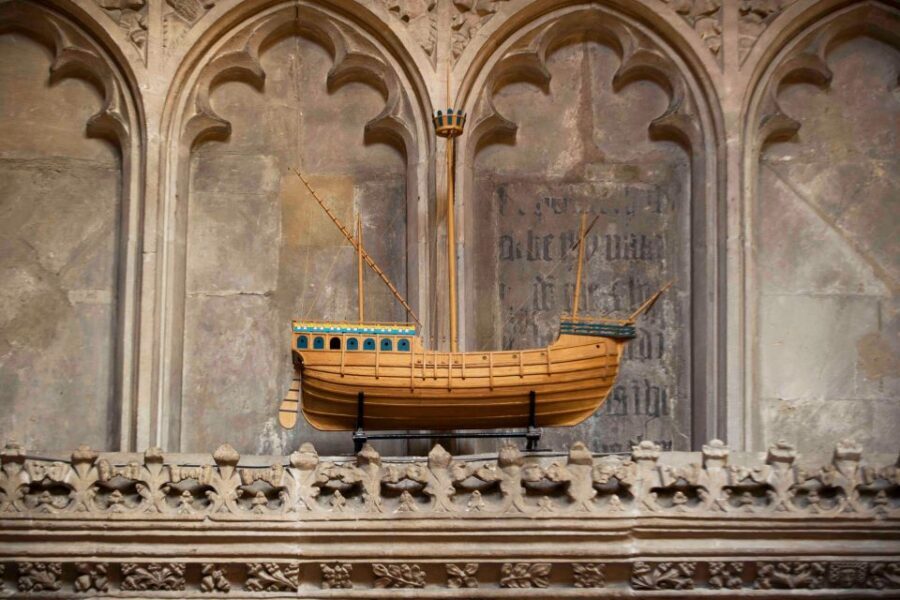
Once you’re inside, the tour steers you toward the church’s internal “big picture” moments.
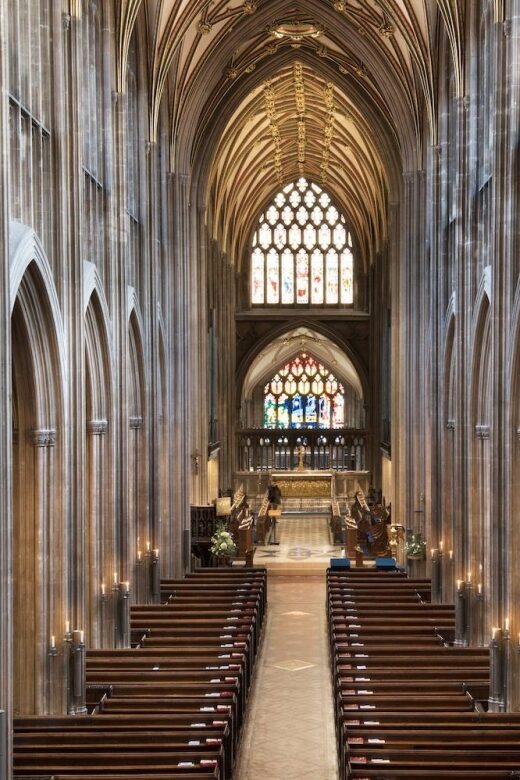
At the west end, you’re meant to take in the view toward the chancel and altar. Then the guide points out the vaulted ceiling and its over 1,200 individual roof bosses. These are decorative carved groin-stone pieces, and once you start noticing them, the ceiling stops looking like a ceiling and starts looking like a carved map.
The church is also a showcase of English perpendicular Gothic architecture—those soaring pillars and strong vertical lines. For you, that means the best photos and the most satisfying moments will likely come from standing still and tilting your head up, then walking a few steps to compare how the geometry changes.
This is also where having a good guide matters. In the best tours, the guide doesn’t just point. They explain why the builders cared about these shapes and surfaces, and they help you read the visual language without needing to be an architecture expert.
St John’s Chapel stained glass: the color that still survives
Next up is St John’s Chapel, where the focus shifts from the overall structure to a concentrated moment of medieval art.
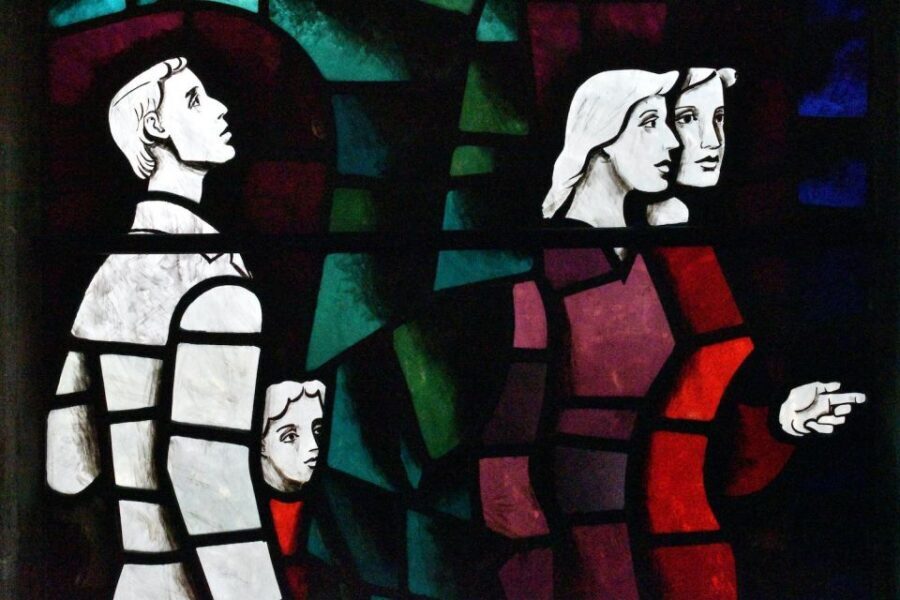
You’ll see the church’s remaining medieval stained glass, dating from the C14th. That time period matters because medieval glass often feels almost impossibly old once you’re standing in front of it. Even when you’re not chasing symbolism, stained glass gives you a different way to experience the church—less about stone and more about light, color, and how the church shaped mood.
This stop is valuable because it breaks the rhythm. After exterior carvings and big architectural views, St John’s Chapel gives your eyes a rest and a different kind of detail to focus on.




North Transept and the mysterious effigy
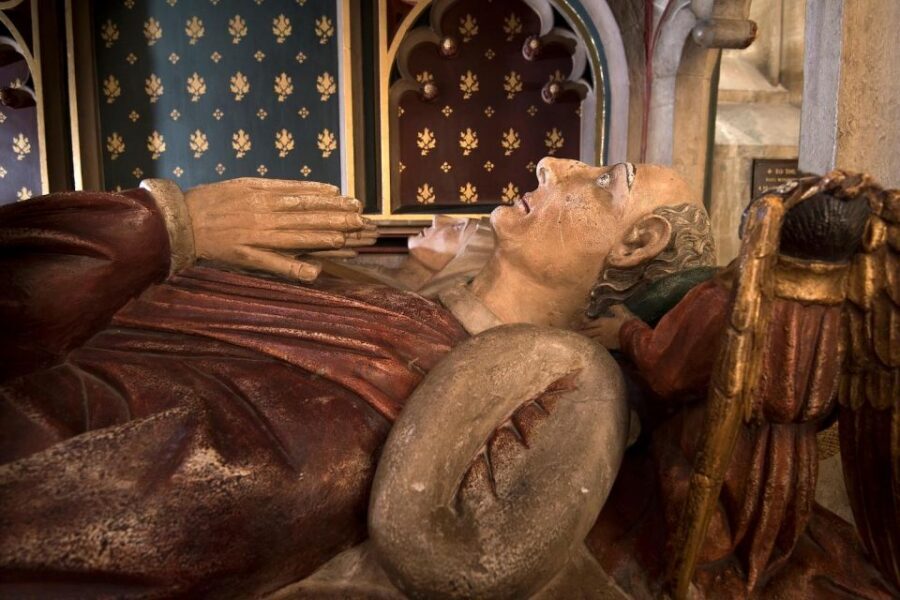
In the North Transept, the tour introduces a figure that adds a layer of unresolved history: a mysterious effigy of an early medieval knight.
The association is tied to Robert de Berkeley, who gave water supply to the church in 1190, but the tour makes it clear that nobody really knows who the effigy represents. What you’re meant to appreciate is the uncertainty itself. The effigy is probably older than the church building, which makes it feel like a living puzzle embedded into the site.
If you like monuments, this is one of the more fascinating moments. It’s not a simple name-and-date lesson; it’s a reminder that medieval history can be partial, and sometimes the building keeps secrets longer than any document.
The Lady Chapel: Harry Stammers stained glass and a gothic screen
From the North Transept, the route goes to the C14th Lady Chapel, where the architecture and art get more intimate.
You’ll see a gothic screen, plus stained glass windows. The windows are credited to artist Harry Stammers in the early 1960s, which is a helpful reminder that St Mary Redcliffe isn’t frozen in time. Even in the 20th century, people cared enough to add and restore with care.
If you’re wondering why this matters, here’s the practical takeaway: the stained glass isn’t just a medieval museum piece. It’s part of a continuing story of how the church lives and changes through the ages.
South Transept tombs and the spire that fell
Next is the South Transept, where the tour turns toward wealth, power, and restoration after catastrophe.
You’ll visit the polychrome stone altar tomb of William Canynges II (c. 1399–1474) and his wife Joan. The tour connects Canynges to Bristol civic life as an MP and Mayor of Bristol, and it also credits him with rebuilding work after major damage.
The big event here is the spire. After lightning hit and the spire collapsed, parts of the nave were destroyed. Later rebuilding efforts shaped what you see now, and that’s why the tomb matters on this tour: it isn’t just a person’s resting place. It’s a marker of how Bristol’s merchant elite responded when the church took a hit.
One extra note from the broader experience people have had: some guides add musical and interpretive touches. In particular, organ-related demonstrations show up in some tours led by guides like Bryan Anderson, and that can add a moving layer to an already dramatic space. If you care about sound as part of a church experience, it’s worth keeping your eyes open and listening for those moments.
Medieval graffiti and merchants’ marks you can finally see
As you move around the church, the guide draws attention to the church’s artwork, carvings, effigies, and monuments—but the tour’s standout theme for many people is the wall-level detail.
You’ll look for medieval graffiti and merchants marks that have adorned the walls for centuries, and the tour emphasizes that some of these markings are only now being discovered. That’s the magic here: you start seeing the church not only as a grand monument but as a surface that people used, worked around, and changed over time.
For you, this means you should slow down when the guide gestures at wall areas. The best part isn’t the biggest monument. It’s the small marks that turn the church into a record of everyday human presence alongside elite patronage.
The Chatterton Room: a hidden upper space worth planning for
The final highlight is the hidden space above the North Porch: the Chatterton Room, named for Bristol’s boy poet Thomas Chatterton (1752–1770), often described as the father of English Romantic Literature.
This is the stop that makes the tour feel special, and it also comes with the key practical constraint. Access is via a 75-step spiral staircase, so it’s not accessible for people who can’t climb stairs.
That matters, but the tour doesn’t leave everyone out. Most of the experience happens in the main church body, which is reachable via the south entrance and is described as level. If you can’t do the stairs, you can still join the main part and get the architecture, stained glass, and stories without forcing the final climb.
If you can do stairs, take it slow. This is one of those “hidden-in-plain-sight” moments where you’re stepping into an upper layer of the church that most casual visits never reach.
Price and timing: $8 for 90 minutes that feel earned
At about $8 per person for a 90-minute guided walking tour, the value comes from three things.
First, it includes access to hidden spaces normally closed—that’s not common at this price point. Second, it’s structured around the church’s hardest-to-tell stories: sea-linked Bristol ties, medieval merchant patronage, and Gothic architectural features that become understandable with guidance. Third, the tour is paced so you’re not just checking boxes. People highlighted that tours can be well paced and responsive, not rushed.
You’ll also be dealing with a real church environment. That means there are lots of surfaces to look at, changing light conditions, and some sections where standing still helps a lot. Bring your patience for the small moments, and you’ll get more out of it.
Who should book this St Mary Redcliffe church tour
I’d put this tour at the top of your list if you fit any of these:
- You like medieval architecture details and want help reading what you see
- You enjoy stories about Bristol merchants, MPs, and maritime links
- You want stained glass plus carved stone and monuments in one route
- You want access to areas normally closed, especially if the Chatterton Room is on your wishlist
It’s less ideal if stairs are a hard no. The Chatterton Room is the only major accessibility restriction noted, but it’s still a meaningful part of the tour experience for many people.
Should you book this guided tour of St Mary Redcliffe?
If your goal is to understand why St Mary Redcliffe is considered one of England’s finest churches, this tour is a strong bet. For a modest fee, you get structured stops that connect the North Porch, stained glass, tombs, and hidden-room history into one clear arc. And the guided element matters here: the church is visually rich, but it becomes truly satisfying when you know what to look for.
Book it if you can climb stairs or you’re happy focusing on the main accessible route. Skip it only if stairs are not possible for you and you mainly wanted the Chatterton Room specifically.
FAQ
FAQ
How long is the St Mary Redcliffe guided tour?
The tour lasts about 90 minutes.
How much does the tour cost?
The price listed is $8 per person.
Where do I meet the guide?
Meet inside the church near the main entrance by the visitor’s desk.
What areas of the church are normally closed that this tour accesses?
The tour includes access to hidden spaces, including the Chatterton Room high above the North Porch, which is normally closed.
Is the Chatterton Room accessible for people who can’t climb stairs?
No. The Chatterton Room is reached by a 75-step spiral staircase. Most of the tour takes place in the main church body, which is accessible via a south entrance and is level, so you can still join the main part.
Is the tour offered in English?
Yes. It’s a live guided tour in English.
Is there a way to keep plans flexible with booking and cancellation?
The activity notes free cancellation up to 24 hours in advance for a full refund, and a reserve now & pay later option.