REVIEW · LONDON
London: Official Natural History Museum Tour – Architecture
Book on GetYourGuide →Operated by Natural History Museum · Bookable on GetYourGuide
The Natural History Museum is more than a place to look. It’s a building you can read, stone by stone, and this architecture-focused tour helps you do it fast. You’ll zero in on gargoyles, carvings, and high decorative ceilings, plus the nature-themed details hidden in the façade.
I especially love how the guide keeps the story anchored in what the building is made of. You’re not just hearing dates and design terms—you’re seeing how the design pays homage to nature, from the late-1800s construction to the museum’s newer parts. And you’ll also get a very human connection: a carved monkey with a human face that looks like a nod to Charles Darwin.
One thing to consider: this is a 1-hour, architecture-first experience. If you’re hoping for a deep route through every gallery or to spend long hours on collections, you may still want extra museum time after the tour.
In This Review
- Key Highlights You’ll Actually Notice
- Why This Architecture Tour Feels Different
- Getting Oriented at Exhibition Road (Not the Usual Entrance)
- The Late-1800s Story: Romanesque Design Built Like a Nature Map
- Spotting the Terracotta Menagerie (And the Darwin Clue)
- Original Sketches to New Additions: What You’ll See Inside
- Ending in the Darwin Centre (Why That Finish Works)
- Guide Quality: The Main Reason People Get Great Reviews
- Headsets, Queue Skipping, and Small-Group Comfort
- Price and Value: What $20 Buys You in Real Terms
- Who This Tour Is Best For (And Who Might Skip It)
- Should You Book This Architecture Tour?
- FAQ
- How long is the Natural History Museum architecture tour?
- How large is the group?
- Where do I meet the guide?
- Where does the tour end?
- What’s included in the ticket price?
- Are temporary exhibitions included?
- Is an audio guide included?
- Is the tour wheelchair accessible?
- Is it suitable for young children?
- Do I need to buy an exact time right away?
- What’s the cancellation policy?
Key Highlights You’ll Actually Notice
- Romanesque exterior details that turn into a guided “spot-the-story” walk
- Terracotta animals built into the stonework, including the Charles Darwin look-alike monkey
- Digital copies of original sketches, drawings, and plans from the late-1800s era
- A clear, engaging guide format that stays easy to hear, even in busy periods
- Finish inside the Darwin Centre, so you see how the museum has grown
Why This Architecture Tour Feels Different
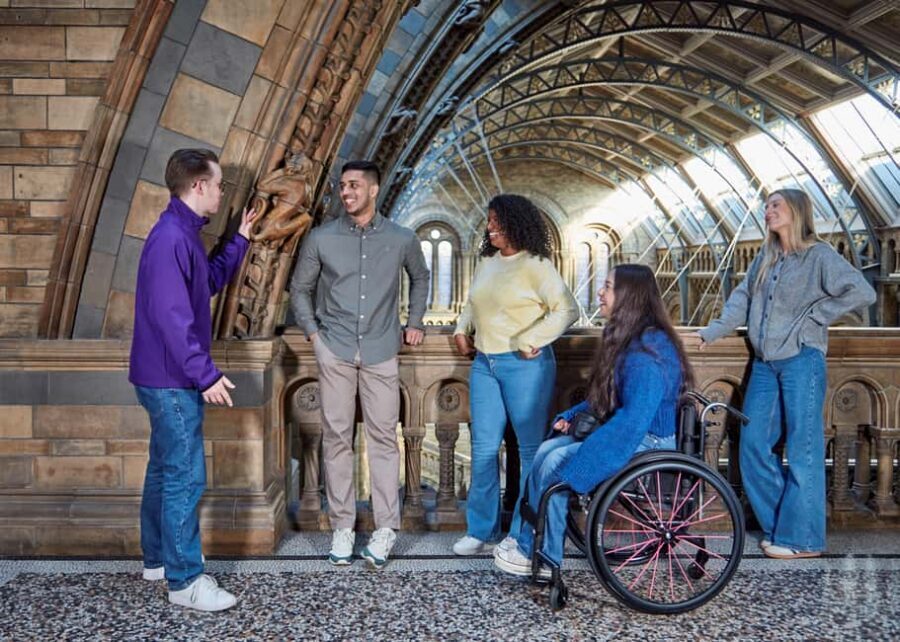
Most museum tours ask you to look at objects. This one asks you to look at the building itself, and that’s a smart shift. The Natural History Museum’s façade and interiors are loaded with symbolism, and the guide gives you the key so you don’t just pass by details on autopilot.
I like that the tour connects design to meaning. The building is described as a striking example of Romanesque architecture, built in the late 1800s, with elements that pay homage to nature. Once you start noticing that theme, the place feels less like a backdrop and more like a living exhibit made of stone.
You also get a time-efficient format. It’s small-group and designed to fit into an hour, which makes it ideal if you’re juggling multiple London stops. And because it includes general museum entry, you’re not locked into a quick-and-vanish visit—you can continue exploring on your own afterward.
You can also read our reviews of more historical tours in London

Getting Oriented at Exhibition Road (Not the Usual Entrance)
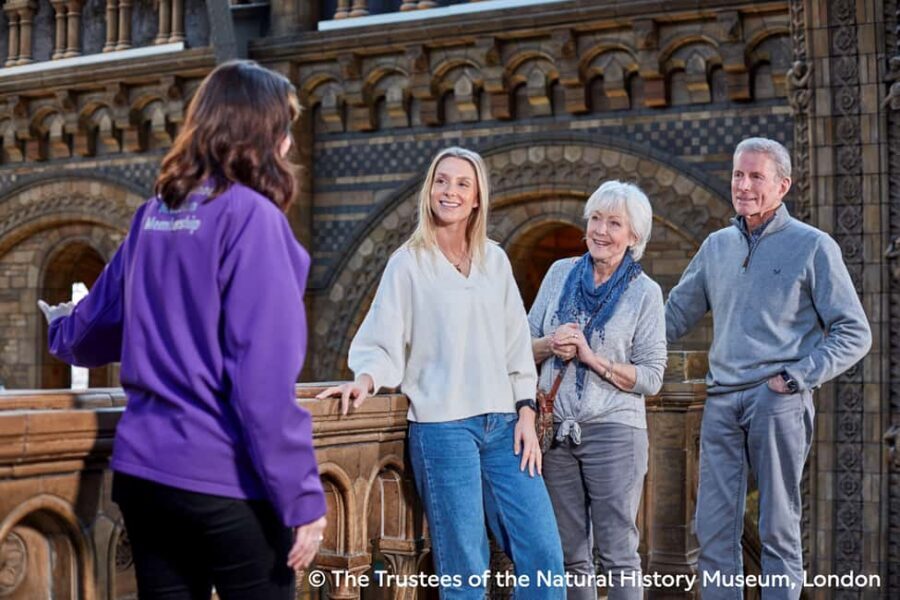
This tour starts in a spot that’s easy to miss if you arrive assuming there’s only one main entrance. You meet outside the Natural History Museum staff/Flett theatre entrance on Exhibition Road, opposite the Victoria & Albert Museum. It’s next to the public museum entrance on Exhibition Road, and it’s explicitly not the main Cromwell Road entrance accessed through the gardens.
If you like to arrive calm (not sprinting), I recommend doing a quick check of where you’re standing before you join the group. The exact location is also given in what3words as: ///bunny.moment.seated.
The payoff for finding the right doorway is that you’ll start the architectural story in the correct place—then move into the building with the guide’s plan in mind.
The Late-1800s Story: Romanesque Design Built Like a Nature Map
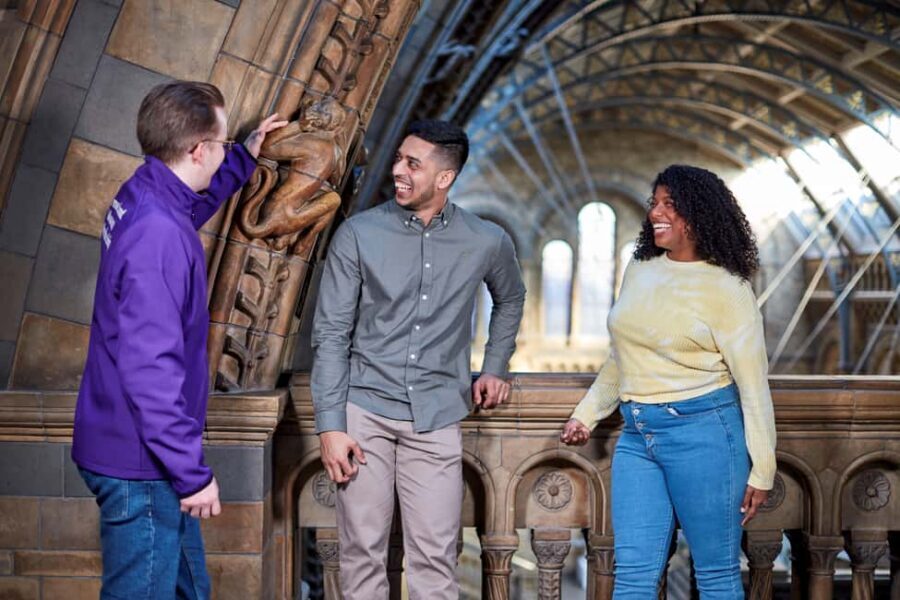
The tour’s core idea is simple: the museum holds specimens, sure—but it also hides a menagerie in its own stonework. The guide points out imposing gargoyles, intricate carvings, and high decorative ceilings. Even if you’ve walked the museum halls before, this kind of framing changes what you notice.
You’ll learn that the building, created in the late 1800s, is one of Britain’s most striking examples of Romanesque architecture. The guide helps you understand that Romanesque isn’t just a style label. It’s a design approach with visible choices—texture, form, and ornament—that make the exterior feel like a carefully crafted world.
Then comes the fun part: looking beyond the specimens to the architecture itself. The tour highlights a whole set of terracotta animals worked into the design. It’s the kind of detail you’d likely miss if you’re just scanning for exhibits, but once someone points it out, your eyes start hunting for more.
Spotting the Terracotta Menagerie (And the Darwin Clue)
One of the most memorable elements of the tour is the way it turns architecture into a puzzle you can solve. You’re guided to notice terracotta animals embedded in the stonework—so instead of seeing the museum as one flat façade, you see it as a themed surface with characters.
A standout detail is the carved monkey with a human face, which the tour says bears a striking resemblance to Charles Darwin. That’s not just a fun fact; it changes how you think about the museum. Darwin isn’t only a historical name tied to natural science—you’re shown a way the museum’s design visually references him.
And this is where the small-group format helps. In a group, you can hear the guide and still get close enough to actually see what they point to. That means less “I think I saw something” and more “Oh, there it is.”
If you’ve been to the Natural History Museum before, this is the part that can still surprise you—because it shifts attention from what’s behind glass to what’s carved in stone.
Original Sketches to New Additions: What You’ll See Inside
The tour isn’t only about what’s outside. It also moves into the museum’s history of design decisions. Before shifting into the museum’s modern updates, you’ll see digital copies of the original sketches, detailed drawings, and plans for the building from the late 1800s era.
That matters more than it sounds. Looking at the architectural plan approach helps you connect ornament and layout to intent. You stop treating the building like a finished monument and start seeing it as a project with drafts, revisions, and a clear idea of what it wanted to communicate.
After that, the tour covers twenty-first-century additions. Instead of ignoring the new work, it frames the museum as something that keeps evolving while still honoring its nature-themed identity. For readers who worry modern upgrades will erase the old character, this tour’s approach reassures you: the guide actively shows you how the story continues.
You can also read our reviews of more museum experiences in London


Ending in the Darwin Centre (Why That Finish Works)
The tour finishes inside the newest part of the museum building, the Darwin Centre. Ending here is a clever choice because it gives you a natural sense of progression: past design decisions in the late 1800s, then the newer chapter.
It also ties back to Darwin as a theme. You start with exterior nature symbolism and end in an area named for Darwin, which makes the hour feel like a complete arc rather than a random walk.
If you like tours that don’t cut off too abruptly, this is a good structure. You won’t just get pointed back outside; you’ll finish within the museum building so you can keep going if you want.
Guide Quality: The Main Reason People Get Great Reviews
What really pops in the feedback is how strong the guide experience is. One reviewed highlight is Glenn Harper, described as amazing and passionate, guiding people through every corner. The same comments emphasize that Glenn pointed out details that are essentially hard to know or notice without help.
Another repeated theme is clarity. The guide is described as speaking clearly enough for groups with tourists from different places, and audible even with museum background noise. That’s a big deal in a busy landmark like this, where you can easily end up squinting at signage instead of listening to the story.
I also appreciate that the guide stays engaging the whole time. Even for people who had been to the museum before, the tour is described as still useful because it calls attention to small architectural details you can miss on a self-guided visit.
Headsets, Queue Skipping, and Small-Group Comfort
The tour includes skip-the-queue entry plus general museum entry, so you’re not wasting time trying to find your way into a crowd. During peak visitor hours, headsets are provided, which makes a difference if you’re visiting at a busy time of day. It’s also a practical nod to how long people actually want to listen while standing.
The group size is limited to 7 participants, keeping the experience personal enough that questions feel possible and attention stays on the guide’s points. If you’re the kind of traveler who likes small groups because you don’t spend half the tour guessing what you’re supposed to look at, this fits.
Duration is 1 hour, which is short enough to fit into a jam-packed day but long enough to cover both historical and modern parts of the building.
Price and Value: What $20 Buys You in Real Terms
At $20 per person for a 1-hour guided architecture tour, you’re paying for interpretation. You’re not just buying access to the museum; you’re buying someone’s ability to direct your eyes to details you’d likely miss.
That value gets stronger because the tour includes:
- General museum entry
- Skip-the-queue
- A live English guide
- Headsets during peak visitor hours
You don’t have to pay extra for an audio guide (audio guide is not included), and you’re not spending your limited time on temporary exhibits that this tour doesn’t cover.
So for most people, the question isn’t whether the Natural History Museum is worth paying for. It’s whether you want a guided architecture lens. If that’s your style, $20 feels like a good trade for one focused hour.
Who This Tour Is Best For (And Who Might Skip It)
This tour is a great match if you:
- enjoy architecture and want a reason to look closely
- like science history tied to visual details, not just names in textbooks
- want an efficient museum plan that still feels specific
- are visiting for the first time and want the building’s “theme” explained
It’s also a good option if you’ve been to the museum before. The tour’s strength is noticing details—especially the nature-themed stonework and the Darwin reference—so repeat visits can still feel fresh.
You might skip it if you’re mainly after temporary exhibitions, because paid temporary exhibitions are not included. Also, it’s not suitable for children under 4, so plan accordingly if you’re traveling with very young kids.
Should You Book This Architecture Tour?
I think you should book it if you want your Natural History Museum visit to feel intentional. The building has layers, and this tour gives you a fast way to decode them—Romanesque features, terracotta animals, and even the Darwin connection through carved details.
If your day is packed and you don’t want to spend hours hunting for what to notice, the 1-hour small-group format is a practical win. And because the tour includes general entry, you’re not just paying for a walk—you’re also set up to continue exploring afterward.
My only caution is the obvious one: it’s not a full museum takeover. If you want a long, gallery-by-gallery tour of collections and temporary exhibits, this isn’t that. But if you want architecture and story, this is one of the more focused ways to experience the museum.
FAQ
How long is the Natural History Museum architecture tour?
It lasts 1 hour.
How large is the group?
The group is small, limited to 7 participants.
Where do I meet the guide?
Meet outside the Natural History Museum staff/Flett theatre entrance on Exhibition Road, opposite the Victoria & Albert Museum. It is next to the public entrance on Exhibition Road, and it is not the main Cromwell Road entrance accessed through the gardens.
Where does the tour end?
The tour ends inside the Darwin Centre, the newest part of the museum building.
What’s included in the ticket price?
The tour includes a guide-led tour in English, general museum entry, and skip the ticket line. Headsets are provided during peak visitor hours.
Are temporary exhibitions included?
No. Entry to paid temporary exhibitions is not included.
Is an audio guide included?
No. An audio guide is not included.
Is the tour wheelchair accessible?
Yes, the tour is wheelchair accessible.
Is it suitable for young children?
It is not suitable for children under 4 years.
Do I need to buy an exact time right away?
You can reserve now & pay later, and you can check starting times based on availability.
What’s the cancellation policy?
You can cancel up to 24 hours in advance for a full refund.